

Why CRM Management is Essential for Your Business
CRM management stands for Customer Relationship Management and refers to systems businesses use to manage their interactions with current and potential customers. At its core, CRM management helps companies stay connected with customers, streamline processes, and ultimately boost profitability. But what does it really involve?
Here’s what CRM management covers:
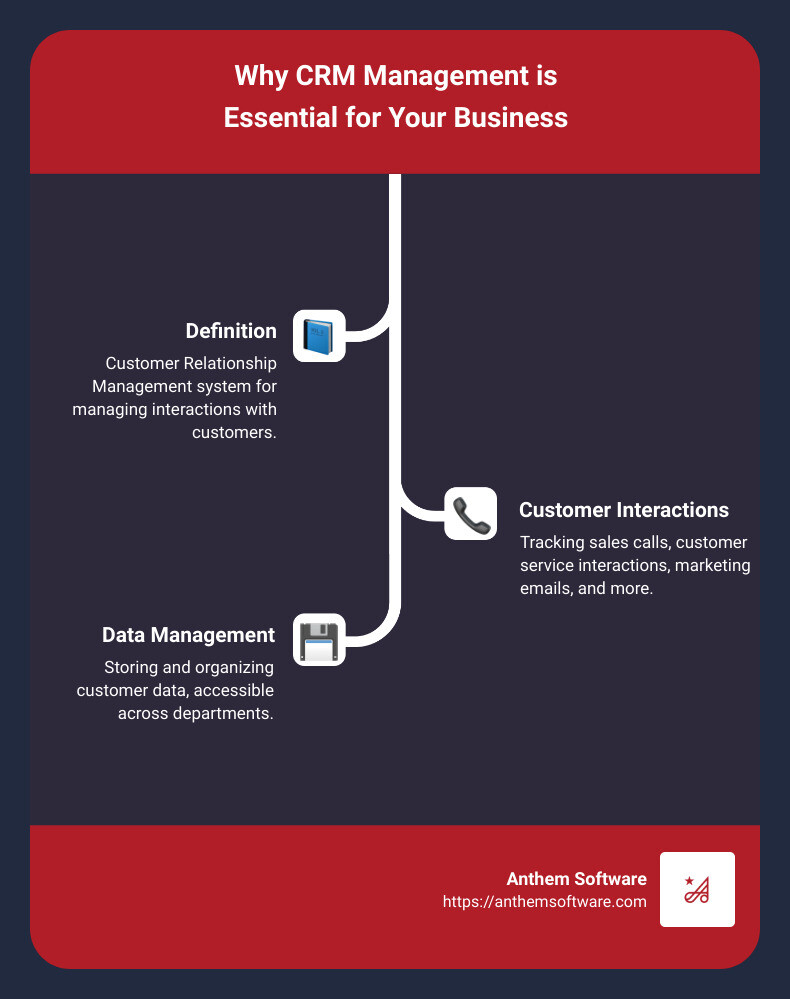
- Definition: CRM stands for customer relationship management, a system for managing interactions with customers to improve relationships and grow your business.
- Customer Interactions: This includes tracking sales calls, customer service interactions, marketing emails, and more.
- Data Management: A good CRM system stores and organizes customer data, making it accessible and useful across departments.
CRM systems provide a unified customer profile, often referred to as a “single source of truth.” This ensures everyone at your company can access the same data to offer high-quality customer service. Plus, it centralizes information, cutting down on administrative work and reducing the risk of losing valuable data when employees leave.
I’m Joe Amaral. With over a decade of experience in sales and management, including founding multiple digital marketing startups, I’ve seen how essential CRM management is for streamlining customer interactions and data management.
What is CRM Management?
CRM management stands for Customer Relationship Management. It involves a mix of practices, strategies, and technologies that companies use to handle customer interactions and data throughout the customer lifecycle.
Practices
CRM practices are all about improving customer relationships. This includes keeping track of every interaction a customer has with your company. Whether it’s a phone call, email, or social media message, CRM systems record all this data. This helps businesses understand customer needs and preferences.
Strategies
CRM strategies focus on customer retention and sales growth. For example, by analyzing customer data, businesses can identify trends and create targeted marketing campaigns. This ensures customers receive relevant information, improving their overall experience.
Example: A retail company might use CRM data to identify customers who frequently buy winter clothing. They can then send personalized emails with discounts on new winter arrivals, increasing the chances of repeat purchases.
Technologies
CRM technologies are the tools that make all of this possible. Modern CRM systems are often cloud-based, offering real-time access to customer data from anywhere. They integrate with other business systems like email, social media, and even accounting software.
Key Technologies in CRM:
– Cloud Computing: Provides real-time data access and eliminates complex installations.
– Artificial Intelligence (AI): Helps predict customer behavior and automate routine tasks.
– Data Analytics: Allows businesses to analyze customer data for better decision-making.

CRM management is essential for any business looking to improve customer service, increase sales, and streamline operations. By combining effective practices, smart strategies, and cutting-edge technologies, companies can create a seamless and personalized customer experience.
Next, let’s dive into the different types of CRM systems and how they can benefit your business.
Types of CRM Systems
CRM systems come in various types, each designed to meet specific business needs. Understanding these types can help you choose the right one for your company.
Collaborative CRM
Collaborative CRM focuses on improving communication and collaboration between your company and its customers. It ensures that all departments—sales, marketing, and customer service—work together seamlessly.
Key Features:
– Unified Customer Data: All departments have access to the same customer information, ensuring consistency.
– Communication Channels: Integrates multiple communication channels like email, phone, and social media.
– Customer Interaction: Tracks every interaction, providing a 360-degree view of the customer.
Example: Imagine a customer contacts your support team about an issue. With collaborative CRM, the support agent can see the customer’s previous interactions with sales and marketing, allowing them to provide a more informed and personalized response.
Analytical CRM
Analytical CRM is all about data analysis. It helps businesses make informed decisions by analyzing customer data and identifying trends.
Key Features:
– Data Mining: Extracts valuable insights from large datasets.
– Customer Segmentation: Groups customers based on behaviors and preferences.
– Predictive Analytics: Uses AI to forecast future customer behaviors.
Example: Kimberly-Clark used analytical CRM to track the ROI of their promotions. By analyzing which promotions were most effective, they redirected $20 million in spending, increasing profits significantly.
Operational CRM
Operational CRM focuses on automating and streamlining business processes. It integrates sales, marketing, and customer service functions to improve efficiency.
Key Features:
– Sales Force Automation: Tracks customer interactions and automates sales tasks.
– Marketing Automation: Automates repetitive marketing tasks, like email campaigns.
– Service Automation: Streamlines customer service processes, often using chatbots and automated response systems.
Example: Brother International used operational CRM to improve their call center efficiency. By identifying customers quickly and providing standardized responses, they reduced call times by 43 seconds, saving $855,000 annually.
Understanding the different types of CRM systems—collaborative, analytical, and operational—can help you choose the right one for your business needs. Each type offers unique features that can improve your customer relationship management efforts.
Next, let’s explore the key features of CRM systems and how they can benefit your business.
Key Features of CRM Systems
CRM systems come packed with features designed to help businesses manage customer relationships more effectively. Here are some of the key features you should know about:
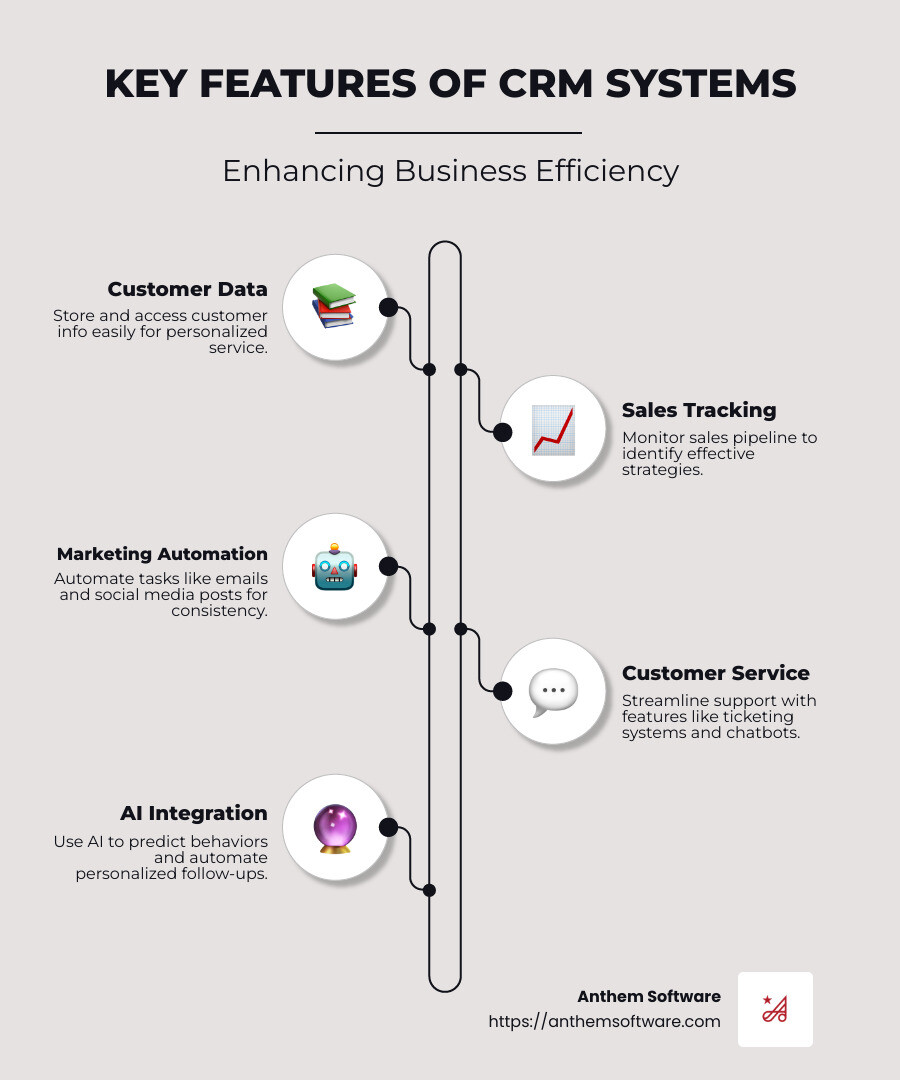
Customer Data
A CRM system is like a boostd address book. It stores customer information such as names, addresses, email addresses, and phone numbers in one place. This makes it easy for you to access and update customer details.
Why it matters: Having all this information in one place helps you provide personalized service. For example, if a customer calls with a question, you can quickly pull up their history and offer a custom response.
Sales Tracking
Sales tracking features allow you to monitor every step of the sales process. From the initial contact to the final sale, you can see where each customer is in the sales pipeline.
Why it matters: Tracking sales helps you identify which strategies are working and which aren’t. For instance, if you notice that leads from a particular campaign are converting at a higher rate, you can allocate more resources to that campaign.
Marketing Automation
Marketing automation takes the repetitive tasks out of your hands. It can send automated emails, schedule social media posts, and even segment your audience for targeted campaigns.
Why it matters: Automation saves time and ensures consistency. For example, as soon as a new lead enters the system, they can automatically receive a welcome email, keeping them engaged from the get-go.
Customer Service
CRM systems also improve customer service by streamlining support processes. Features like ticketing systems, chatbots, and automated responses help resolve issues faster.
Why it matters: Faster response times lead to happier customers. For instance, chatbots can handle simple queries instantly, freeing up your support team to focus on more complex issues.
AI Integration
Artificial Intelligence (AI) is becoming a game-changer in CRM. AI can analyze customer data to predict future behaviors, automate repetitive tasks, and even generate personalized follow-up emails.
Why it matters: AI makes your CRM smarter and more efficient. For example, Salesforce Einstein can predict which leads are most likely to convert, allowing your sales team to focus their efforts where they matter most.
Understanding these key features can help you make the most of your CRM system. Next, we’ll dig into the benefits of CRM management and how it can transform your business.
Benefits of CRM Management
Implementing CRM management in your business brings a host of benefits. Let’s break them down:
Improved Customer Service
A CRM system centralizes all customer information, making it easily accessible. This means your support team can quickly pull up a customer’s history and provide personalized service.
Example: When a customer calls with an issue, the support agent can see all past interactions and purchases, allowing for a faster and more custom response. This boosts customer satisfaction and loyalty.
Customer Retention
Keeping existing customers is crucial. CRM systems help by identifying at-risk customers and automating follow-ups.
Fact: According to Harvard Business Review, the cost of winning new clients is five to 25 times more than keeping existing ones. CRM systems can send automated emails to re-engage inactive customers, improving retention rates.
Sales Growth
CRM systems streamline the sales process, making it easier to manage leads and track sales activities.
Story: Aviall Inc. used CRM to improve sales-force productivity. Sales reps tripled their daily calls and expanded their customer base by one-third, leading to a significant increase in sales.
Cost Savings
By automating repetitive tasks and improving workflow efficiency, CRM systems can save your business money.
Statistic: Brother International saved $855,000 annually by reducing call times with a new CRM system. Automation and streamlined processes mean fewer resources are needed to achieve the same results.
Productivity
CRM systems boost team productivity by centralizing information and automating routine tasks.
Features: Email integration, task automation, and sales engagement tools help your team focus on what matters most—building relationships and closing deals. For instance, automated email sequences and smart contact lists can significantly cut down on manual work.
With these benefits, it’s clear that CRM management can transform your business. Next, let’s explore how CRM systems work to bring these advantages to life.
How CRM Systems Work
To understand how CRM systems deliver their many benefits, let’s break down their core components and functionalities: data compilation, customer profiles, interaction tracking, and automation.
Data Compilation
At the heart of every CRM system is data compilation. This involves gathering customer information from various touchpoints—like your website, phone calls, emails, social media, and more—and storing it in one central database.
Fact: According to TechTarget, CRM systems compile data across different channels to provide a unified view of each customer. This means all customer interactions and details are in one place, making it easier for your team to access and use this information.
Customer Profiles
Once data is compiled, CRM systems create detailed customer profiles. These profiles include personal information, purchase history, preferences, and past interactions.
Example: A customer profile might include contact details, a history of purchases, notes from past phone calls, and preferred communication methods. This comprehensive view helps your team provide personalized service and targeted marketing.
Interaction Tracking
Interaction tracking is another crucial feature. It records every customer interaction—whether it’s a phone call, email, social media message, or in-person meeting.
Story: Suppose a customer calls your support team with a complaint. The support agent can instantly see the customer’s entire interaction history, allowing them to address the issue more effectively. This leads to higher customer satisfaction and quicker resolutions.
Automation
Automation is where CRM systems truly shine. They can automate repetitive tasks, such as sending follow-up emails, scheduling appointments, and managing workflows.
Statistic: Brother International saved $855,000 annually by reducing call times with a new CRM system. Automated tasks free up your team’s time, allowing them to focus on more strategic activities.
Features:
- Marketing Automation: Automate email campaigns and social media posts to nurture leads and engage customers.
- Sales Automation: Track leads, manage the sales pipeline, and automate follow-ups to keep prospects moving through the funnel.
- Contact Center Automation: Use prerecorded responses and chatbots to handle routine inquiries, reducing the workload on your support team.
By integrating these components, CRM systems provide a seamless and efficient way to manage customer relationships. This not only boosts productivity but also improves customer satisfaction and drives sales growth.
Now that you know how CRM systems work, let’s discuss how to choose the right CRM for your business.
Choosing the Right CRM for Your Business
Selecting the right CRM management system is crucial for your business. Here, we’ll explore the different types of CRM systems: cloud-based, on-premises, and open-source. We’ll also touch on the unique needs of small businesses.
Cloud-Based CRM
Cloud-based CRM solutions are hosted on the vendor’s servers and accessed online. They are popular due to their flexibility and ease of use.
Benefits:
- Cost-Effective: Vendors like Salesforce and Zoho offer subscription-based pricing, which can be monthly or yearly.
- Scalability: Easily scale up as your business grows without worrying about server capacity or maintenance.
- Accessibility: Access your CRM from anywhere with an internet connection, perfect for remote teams.
Example: A small marketing firm might choose a cloud-based CRM for its user-friendly interface and robust marketing automation tools.
On-Premises CRM
On-premises CRM solutions are hosted on your company’s own servers. This gives you complete control over the software and data.
Benefits:
- Control and Customization: Full control over data security and the ability to customize the CRM to fit specific needs.
- Cost Over Time: While the initial investment is higher, it can be more cost-effective in the long run compared to ongoing subscription fees.
Example: A large enterprise with complex CRM needs might opt for an on-premises solution to ensure data security and compliance.
Open Source CRM
An open-source CRM offers the ultimate flexibility by allowing you to modify the source code to fit your business needs.
Benefits:
- Customization: Modify and adapt the CRM to your unique requirements without additional costs.
- Community Support: Benefit from a community of developers who contribute to improving the software.
Example: A tech startup might choose an open-source CRM for its customizable features and active developer community.
Small Business Needs
For small businesses, choosing the right CRM involves balancing functionality with budget constraints.
Key Considerations:
- Ease of Use: Select a CRM that is intuitive and requires minimal training, like Less Annoying CRM.
- Scalability: Ensure the CRM can grow with your business, handling more customers and data as needed.
- Cost: Look for affordable options that offer essential features without unnecessary extras.
Example: A small retail business might opt for Zoho CRM due to its affordability and comprehensive feature set.
By understanding the different types of CRM systems and considering your specific business needs, you can choose a CRM that will help you manage customer relationships effectively and drive growth.
Next, let’s address some common questions about CRM management to help you make an informed decision.
Frequently Asked Questions about CRM Management
What does CRM management do?
CRM management involves using software to manage your relationships with customers throughout their entire lifecycle. This includes tracking interactions, storing customer data, and automating tasks to improve efficiency.
Key Functions:
- Customer Service Relationships: CRM systems store detailed customer information, making it easier to provide personalized service.
- Sales Growth: By tracking customer interactions and automating follow-ups, CRM helps sales teams close more deals.
- Customer Lifecycle: From lead generation to post-sale support, CRM systems manage every stage of the customer journey.
What are the 3 types of CRM?
There are three main types of CRM systems, each serving different business needs:
- Collaborative CRM
- Purpose: Centralizes customer data to facilitate communication between different departments.
- Example: A sales team can see support tickets and marketing emails, ensuring a unified customer experience.
Benefit: Improves internal collaboration and customer satisfaction.
Analytical CRM
- Purpose: Analyzes customer data to provide insights for decision-making.
- Example: Identifies trends and patterns in customer behavior to tailor marketing campaigns.
Benefit: Helps businesses make data-driven decisions to improve customer retention and sales strategies.
Operational CRM
- Purpose: Automates routine tasks related to customer interactions.
- Example: Automates follow-up emails and schedules appointments.
- Benefit: Increases efficiency and allows teams to focus on high-value activities.
What is CRM with an example?
CRM (Customer Relationship Management) tools streamline how businesses interact with customers. They store customer information, track interactions, and automate processes to improve the customer experience.
Example:
Amazon uses CRM to personalize customer interactions. They send custom recommendations and greetings based on purchase history and browsing behavior. This approach has led to an 80% repeat customer rate.
Case Study:
MBNA Europe saw a 75% annual profit growth by using CRM to screen potential cardholders and retain profitable customers. They achieved a 97% retention rate and saw card usage 52% above the industry norm.
By understanding these aspects of CRM management, you can choose the right system to improve customer relationships and drive business growth.
Conclusion
In today’s competitive landscape, effective CRM management is crucial for business success. At Anthem Software, we understand the importance of leveraging CRM systems to improve customer relationships, drive business growth, and boost customer satisfaction.
Why Choose Anthem Software?
1. Comprehensive CRM Solutions: Our CRM software integrates customer data, sales tracking, marketing automation, and customer service management into one platform. This ensures you have a 360-degree view of your customers, enabling better decision-making and personalized customer interactions.
2. Business Growth: A well-implemented CRM system can significantly drive sales growth. By automating routine tasks and providing detailed insights into customer behavior, our CRM tools help your sales team close more deals efficiently. For instance, MBNA Europe achieved a 75% annual profit growth by using CRM to retain profitable customers and increase card usage.
3. Improved Customer Satisfaction: Customer satisfaction is at the heart of any successful business. Our CRM solutions store detailed customer information, making it easier to provide personalized and timely customer support. This leads to higher customer retention rates and a more loyal customer base.
4. Cost Savings and Productivity: Automating menial tasks like data entry and follow-up emails frees up your team’s time to focus on high-value activities. This not only boosts productivity but also reduces operational costs. For example, companies using CRM systems have reported significant improvements in team efficiency and reductions in acquisition costs.
Ready to Transform Your Business?
Whether you’re a small business or a large corporation, implementing a robust CRM system can revolutionize how you manage customer relationships and grow your business. Don’t miss out on the benefits of CRM management.
Contact Anthem Software today to learn how our CRM solutions can help you achieve your business goals and improve customer satisfaction.
By investing in the right CRM system, you’re not just managing customer relationships—you’re building a foundation for long-term success.