

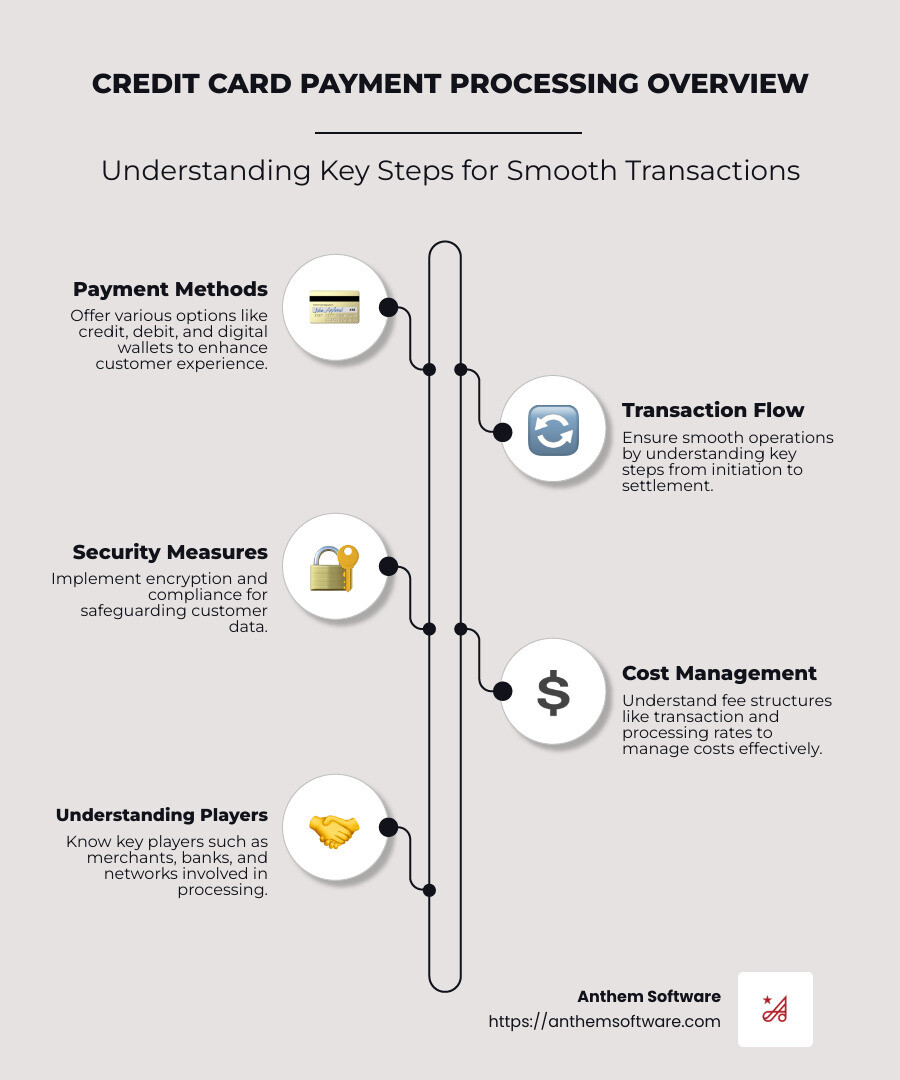
Credit card payment processing is a critical component for businesses aiming to thrive in the increasingly digital marketplace. With over half of Americans favoring debit cards and 36% opting for credit cards, the payment landscape is evolving swiftly. To remain competitive, businesses need to master the essentials of credit card payment processing. Here’s a quick overview:
- Payment Methods: Understanding consumer preferences is key. Offering a variety of options like credit, debit, and digital wallets can improve customer experience.
- Transaction Flow: From initiation to settlement, knowing the steps ensures smoother operations and quicker payments.
- Security Measures: Encryption and compliance are non-negotiable for protecting customer data.
- Costs: Fee structures like transaction fees and processing rates impact your bottom line.
Mastering credit card payment processing involves understanding the players, technology, and trends that define how transactions are handled and secured.
My name is Joe Amaral, and my journey into payment systems began with diverse roles in management and digital marketing. My experience with credit card payment processing comes from spearheading software solutions that improve transaction efficiency and security. With this background, I’ll guide you through the intricacies of payment processing.
Credit card payment processing terms to know:
– Email marketing plan development
– ach payment processing solutions
Key Components of Credit Card Payment Processing
Understanding the key components of credit card payment processing is crucial for any business that wants to accept card payments smoothly and securely. Let’s break down the main players and technologies involved:
Merchant
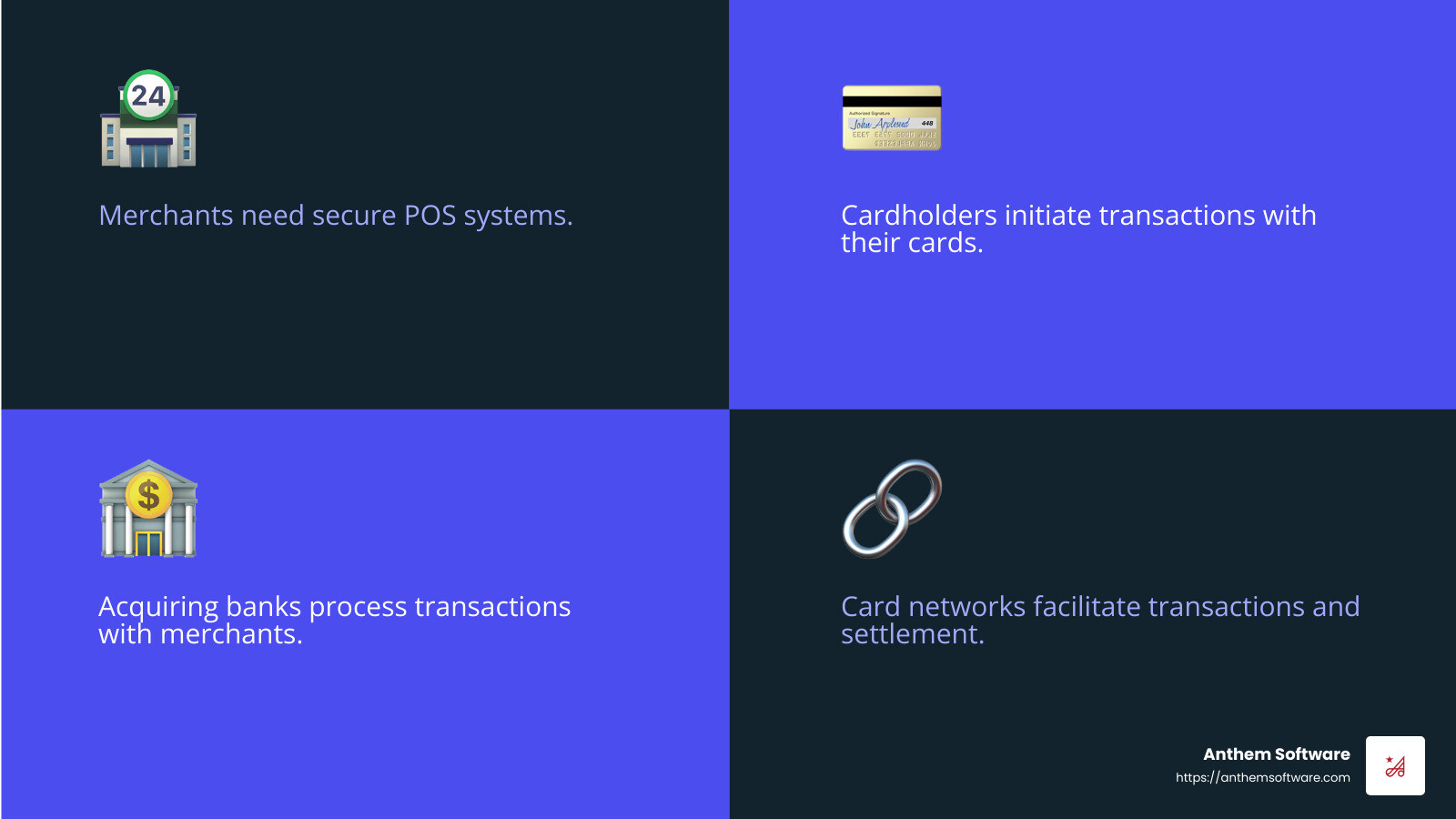
The merchant is the business or individual that sells goods or services and accepts credit card payments. Merchants must set up accounts with payment processors to handle transactions. They are responsible for ensuring the point-of-sale (POS) systems are up-to-date and secure.
Cardholder
The cardholder is the customer who owns a credit card issued by a bank or financial institution. They initiate transactions by providing their card details either in-person or online.
Acquiring Bank
The acquiring bank (or acquirer) partners with merchants to process card transactions. They receive transaction details from the merchant and communicate with the issuing bank to get authorization. Acquiring banks play a vital role in ensuring that funds are transferred correctly.
Issuing Bank
The issuing bank provides credit cards to cardholders. They approve or decline transactions based on the cardholder’s credit status and available funds. The issuing bank is responsible for assessing the risk of each transaction.
Card Networks
Card networks like Visa, Mastercard, American Express, and Find create the infrastructure and rules for processing transactions. They act as intermediaries between acquiring and issuing banks, facilitating communication and settlement.
Payment Gateway
A payment gateway is a technology that transmits payment information from the merchant’s POS system to the acquiring bank. It encrypts sensitive data to ensure security. Payment gateways are pivotal in both physical stores and online environments.
Payment Processor
The payment processor manages the transaction process on behalf of the acquiring bank. It handles tasks like communicating with card networks, obtaining transaction authorization, and managing settlements. Payment processors are the backbone of the payment system, ensuring everything runs smoothly.
POS System
The POS system is the hardware and software used by merchants to accept card payments. In physical stores, this includes card readers and terminals. For online transactions, the POS system integrates with ecommerce platforms and payment gateways.
By understanding these components, businesses can effectively manage credit card payment processing. This knowledge helps ensure transactions are secure, efficient, and compliant with industry standards.
How Credit Card Payment Processing Works
Credit card payment processing involves several steps that enable businesses to accept and process card payments efficiently. Let’s walk through the key stages of this process:
Transaction Initiation
The journey begins when a customer, or cardholder, provides their credit card information to a merchant. This can happen in a physical store by swiping or tapping the card at a POS terminal, or online by entering card details on a website or mobile app.
Authorization Request
Once the transaction is initiated, the merchant’s POS system sends the payment information to a payment gateway. This gateway encrypts the data for security and forwards it to the acquiring bank. The acquiring bank then routes the request through the card network to the issuing bank.
Transaction Authorization
At this stage, the issuing bank verifies the cardholder’s account. It checks for available credit or funds and evaluates the risk of the transaction. If everything checks out, the issuing bank approves the transaction. If not, it declines.
Authorization Response
The issuing bank sends its decision back through the card network to the acquiring bank. The response is then relayed to the payment gateway, which informs the merchant’s POS system whether the transaction is approved or declined.
Transaction Completion
If approved, the merchant completes the sale, providing goods or services to the customer. The transaction is then added to a batch of approved transactions waiting for settlement.
Settlement
At the end of the business day, the merchant submits the batch of transactions to the acquiring bank. The bank requests the necessary funds from the issuing bank through the card network. Once the issuing bank transfers the funds, the acquiring bank deposits the money into the merchant’s account, minus any processing fees.
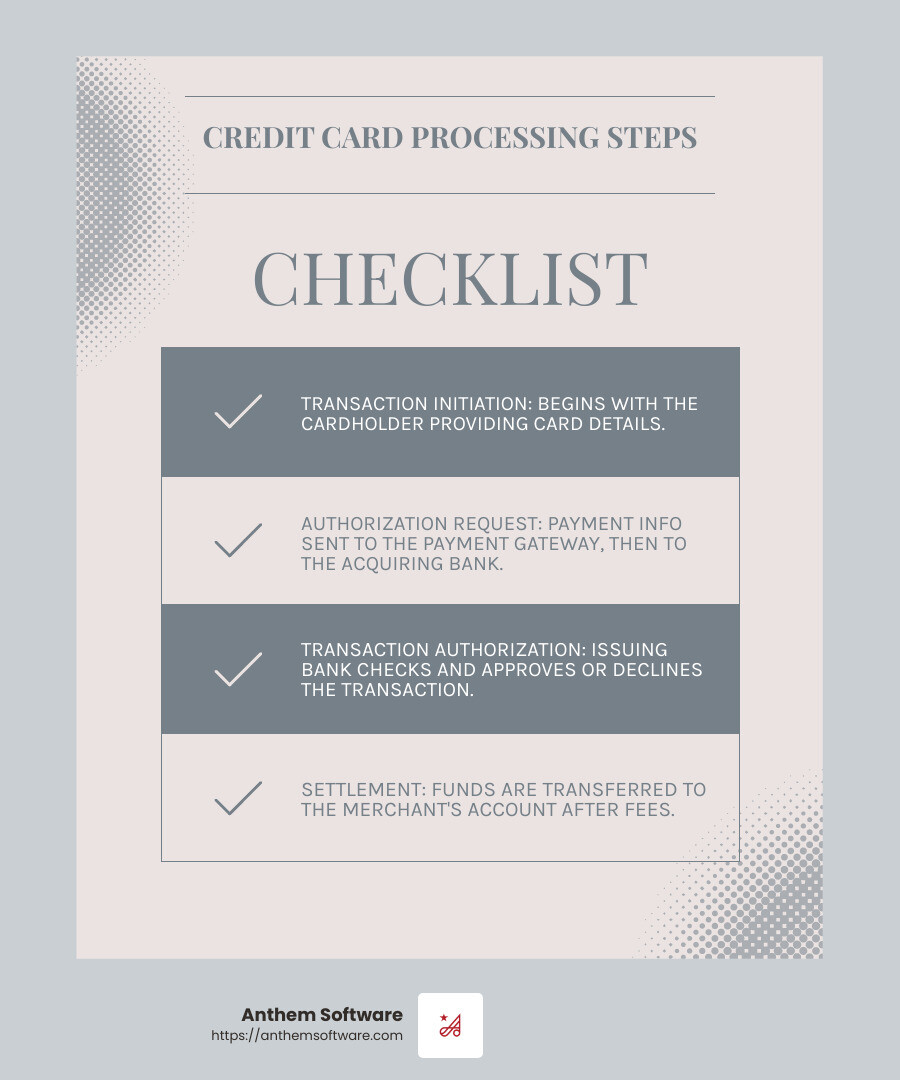
This entire process, from initiation to settlement, ensures that credit card transactions are secure and efficient, allowing businesses to serve their customers seamlessly. Next, we’ll dive into the fees associated with credit card processing and how they impact merchants.
Credit Card Processing Fees and Pricing Structures
When it comes to credit card payment processing, understanding the associated fees and pricing structures is crucial for businesses. Let’s break down the costs involved:
Transaction Fees
Transaction fees are the charges applied each time a customer makes a purchase using a credit card. These are typically a combination of a percentage of the transaction amount plus a fixed fee. For instance, Stripe charges 2.9% + $0.30 per transaction. This fee compensates the payment processor for handling the transaction.
Monthly Fees
Some payment processors charge a monthly fee for access to their services. This can include the use of a payment gateway, reporting tools, and customer support. Monthly fees provide businesses with ongoing access to essential payment processing infrastructure.
Setup Fees
Setup fees are one-time charges for establishing and configuring a merchant account. Not all providers charge setup fees, so compare options. These fees cover the initial setup of your payment processing system.
Terminal Fees
If your business accepts in-person payments, you may need to invest in physical equipment like card readers or POS systems. Terminal fees cover the cost of purchasing or leasing this hardware. For large-scale operations, these fees can add up, so it’s wise to evaluate long-term needs.
PCI-Compliance Fees
To ensure the security of cardholder data, businesses must adhere to the Payment Card Industry Data Security Standard (PCI DSS). Some processors charge an annual fee to maintain PCI compliance, while others offer assistance in achieving compliance.
Chargeback Fees
Chargebacks occur when a customer disputes a transaction. When this happens, the business may incur a chargeback fee, typically ranging from $10 to $35 per incident. High-risk businesses or those with frequent chargebacks may face higher fees, so maintaining a low chargeback ratio is key.
Pricing Models: Interchange-Plus vs. Flat-Rate
Understanding pricing models is vital for selecting the right payment processor:
Interchange-Plus Pricing: This model separates the interchange fees (charged by the cardholder’s bank) from the processor’s markup. It offers transparency and is often favored by established businesses with high sales volumes.
Flat-Rate Pricing: With flat-rate pricing, businesses pay a consistent fee regardless of the card type or transaction method. This model is popular among startups for its simplicity and predictability. Companies like Square and Stripe offer flat-rate pricing, making it an attractive option for new businesses.
Choosing the right pricing structure depends on your business needs and transaction volume. Carefully comparing options and negotiating rates can help minimize costs.
Next, we’ll explore how to choose the right credit card processing provider to meet your business requirements.
Choosing the Right Credit Card Processing Provider
Selecting the right credit card payment processing provider is a crucial decision for any business. Here’s a simple guide to help you make the best choice:
Assess Your Business Needs
Start by understanding your transaction volume, average transaction size, and whether you need in-person, online, or mobile payment processing. If you’re expanding into new markets, ensure the provider supports preferred payment methods and currencies in those regions.
Compare Pricing and Fees
Different providers have different fee structures. Some charge transaction fees, monthly fees, setup fees, and even hardware fees. For example, Stripe is known for its flat-rate pricing, which is straightforward and predictable. Compare these costs to find the best value for your business.
Evaluate Customer Support
Reliable customer support is essential. If your payment system goes down, it can directly affect your sales and customer experience. Providers like Stripe offer 24/7 support through various channels. Make sure your chosen provider can be reached whenever you need help.
Consider Security and Compliance
Security should be a top priority. Choose a provider that complies with the Payment Card Industry Data Security Standard (PCI DSS) to protect your customers’ sensitive information. This compliance is crucial for minimizing fraud risks and maintaining customer trust.
Review Integration Compatibility
Ensure the provider’s payment processing solution is compatible with your existing POS system, ecommerce platform, and accounting software. Seamless integration will make your operations smoother and more efficient.
Research Provider Reputation
Look for reviews and testimonials from other businesses. A provider with a solid reputation for reliability and customer satisfaction is a safer choice. Consider asking industry peers for recommendations to ensure you partner with a vetted provider.
Analyze Additional Features and Services
Some providers offer value-added services like advanced reporting, recurring billing, or multicurrency processing. Decide which features are necessary for your business and which would be nice to have. For instance, Helcim offers a virtual terminal and subscription management, which can be beneficial for certain businesses.
By carefully evaluating these factors, you can choose a credit card processing provider that aligns with your business needs, budget, and long-term goals. This decision will play a significant role in your business’s ability to provide a secure, efficient, and satisfying payment experience for customers.
Next, we’ll address some frequently asked questions about credit card payment processing.
Frequently Asked Questions about Credit Card Payment Processing
How long does it take for a credit card payment to process?
The time it takes for a credit card payment to process can vary. Typically, it takes 1-5 business days for the funds to be transferred from the issuing bank to the merchant’s account. This period can depend on factors like the payment processor and the type of transaction, whether it’s online or in-person.
Once the transaction is authorized, the funds are held until they are posted to the merchant’s account during the settlement process. Some payment processors offer next-day funding, but usually, there is an additional fee for this expedited service.
What are the steps of the credit card payment process?
The credit card payment process involves several key steps:
Authorization: The customer initiates a transaction by providing their card details. The payment gateway sends this information to the acquiring bank, which requests authorization from the issuing bank through the card network.
Authentication: The issuing bank verifies the cardholder’s information and checks for sufficient funds or credit. It also assesses the risk of the transaction. If everything checks out, the bank approves the transaction.
Authorization Response: The issuing bank sends an approval or decline message back through the card network to the acquiring bank, which then informs the merchant.
Transaction Completion: Once approved, the merchant provides the goods or services to the customer. The transaction is then added to a batch of transactions to be settled.
Settlement: At the end of the day, the merchant submits the batch of approved transactions to the acquiring bank. The acquiring bank requests the funds from the issuing bank, and once received, deposits them into the merchant’s account, minus any applicable fees.
Is payment processing a good career?
The payment processing industry offers diverse career opportunities and is a promising field for those interested in technology, finance, and sales. As businesses increasingly move to digital payments, the demand for skilled professionals in this sector is growing.
Career paths in payment processing can range from technical roles, such as software developers and security analysts, to business roles like sales representatives and account managers. The industry is known for its dynamic environment and potential for growth, making it an attractive option for those looking to build a career in a and evolving sector.
Moreover, working in payment processing provides the chance to be at the forefront of innovation, as companies continuously develop new technologies to improve transaction security and efficiency. This makes it an exciting field for individuals who are passionate about technology and customer service.
Conclusion
In the changing landscape of digital marketing, small businesses face unique challenges and opportunities. At Anthem Software, we specialize in empowering these businesses with effective B2B email marketing strategies. Our mission is to help small enterprises thrive by leveraging the power of targeted communication and automation.
Anthem Software understands the importance of streamlining operations, especially when it comes to credit card payment processing. By integrating seamless payment solutions, we improve the customer experience and ensure that businesses can focus on what truly matters—growth and innovation. Our payment processing solutions are designed to be easy to implement and manage, offering flexibility and security for businesses of all sizes.
Our expertise in B2B email marketing allows us to create personalized campaigns that resonate with professional stakeholders. This targeted approach not only boosts engagement but also drives significant growth for our clients. By automating up to 90% of daily business tasks, including payment processing and marketing efforts, we free up entrepreneurs to concentrate on strategic initiatives.
Anthem Software is more than just a service provider; we are a partner committed to your success. Our global clientele is a testament to the effectiveness of our solutions, which are custom to meet the diverse needs of small businesses worldwide.
Explore how our payment processing solutions can transform your business and drive success in today’s competitive market. Connect with us to learn more about how we can support your digital marketing and payment processing needs, ensuring your business not only survives but thrives.