

B2B payment platform is more than just a buzzword; it’s a transformative force reshaping how businesses interact financially. Unlike simpler consumer transactions, B2B payments are complex. They involve large sums, negotiations, and longer timelines. These platforms streamline this complexity, ensuring efficiency, scalability, and security. The B2B payments market is booming, having hit $1.5 trillion in 2022, and it’s projected to more than double by 2032. This growth is spurred by digital innovations, making transactions quicker and easier for businesses worldwide.
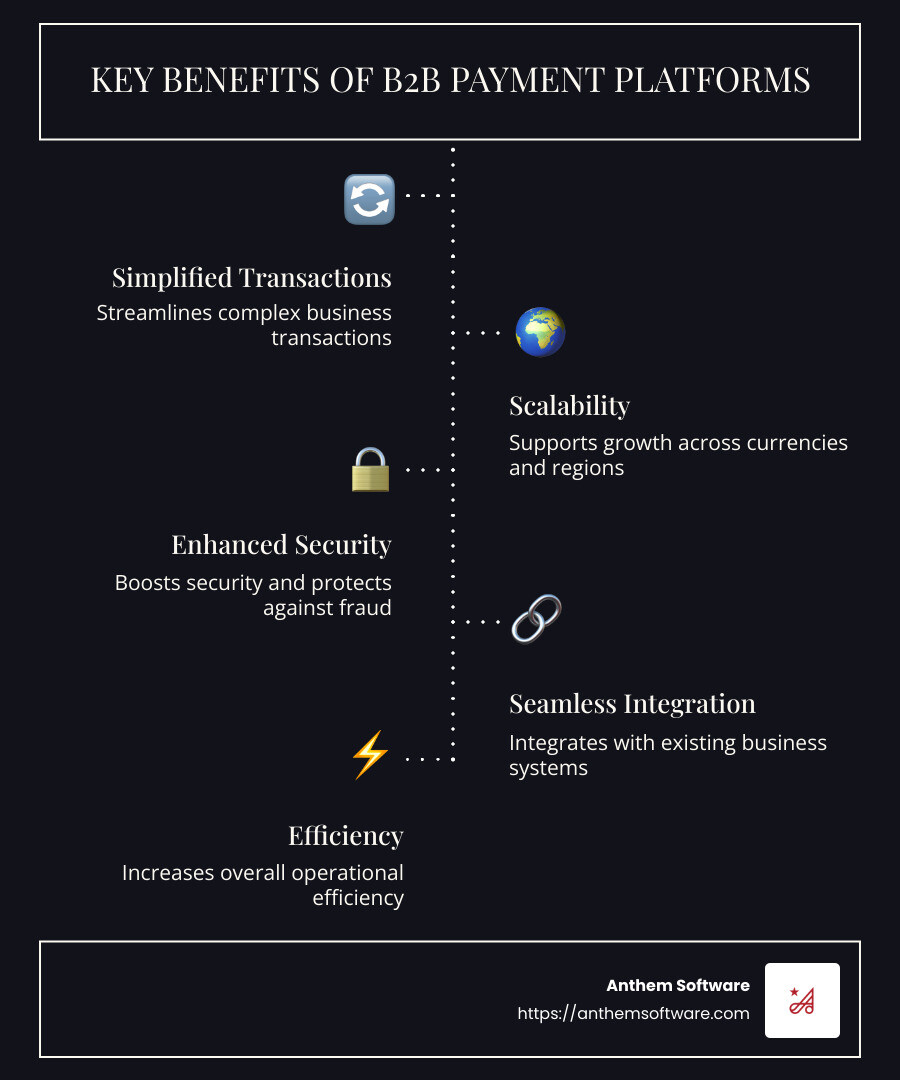
Here’s why B2B payment platform matters:
- Simplifies complex transactions
- Supports scalability across various currencies and regions
- Improves security and fraud protection
- Integrates seamlessly with existing business systems
As a Navy veteran turned digital entrepreneur, I leveraged my skills in digital marketing to help streamline operations for businesses like Anthem Software. Understanding the intricacies of the b2b payment platform has been instrumental in crafting solutions that address these financial complexities.
Find more about b2b payment platform:
– b2b ach payment processing
– b2b credit card processing
– business to business payment
What are B2B Payment Platforms?
B2B payment platforms are specialized systems designed to handle financial transactions between businesses. These platforms simplify the complex process of exchanging goods and services, ensuring smooth interactions between buyers and suppliers.
Transactions in B2B Payments
In a B2B setting, transactions are typically larger and more intricate than consumer payments. They often involve negotiations over payment terms and schedules. Unlike the instant payments seen in consumer transactions, B2B payments might include invoicing and extended payment cycles. This complexity requires a platform that can manage these unique requirements efficiently.
The Role of Buyers and Suppliers
In B2B transactions, both buyers and suppliers play crucial roles. Buyers seek platforms that offer flexible payment terms and security, while suppliers need systems that ensure timely payments and streamline invoicing. A robust B2B payment platform caters to both parties, providing features like customizable payment terms and automated reminders to improve cash flow management.
B2B payment platforms facilitate the exchange of goods and services by supporting various payment methods, such as credit cards, ACH payments, and wire transfers. They also handle multi-currency transactions, which is essential for businesses operating internationally. This feature minimizes currency conversion fees and simplifies cross-border trade.
Unique Requirements of B2B Payments
B2B transactions come with unique requirements that these platforms must address. For instance, they need to integrate with existing accounting software to streamline financial reporting and reconciliation. Security is another critical aspect, with platforms needing to comply with standards like PCI DSS and offer features like encryption and fraud detection.
As digital change continues to reshape the business landscape, B2B payment platforms are becoming indispensable tools for companies looking to optimize their financial operations. They not only manage the complexity of B2B transactions but also provide a secure and scalable solution for businesses of all sizes.
How B2B Payments Differ from B2C Payments
When it comes to payments, businesses and consumers have distinct needs. Understanding these differences is key to choosing the right B2B payment platform.
Volume
B2B transactions typically involve larger sums of money than B2C payments. Businesses often purchase in bulk, leading to higher transaction volumes. This means B2B payment platforms must handle large and frequent transactions efficiently. They need to be robust and scalable to support this high volume without hiccups.
Contract Type
In B2C transactions, purchases are usually straightforward. You buy a product or service, pay for it, and the transaction is complete. B2B transactions, however, are often governed by contracts. These contracts can include complex terms like delivery schedules, payment timelines, and penalties for non-compliance. A good B2B payment platform can manage these contract-based transactions seamlessly, ensuring all terms are met.
Payment Method
Choosing the right platform means ensuring it supports multiple payment methods, catering to the diverse needs of businesses.
Regulations
B2B payments face stricter regulations compared to B2C transactions. This is because they often involve larger sums and cross-border transactions. Compliance with standards like PCI DSS is crucial to protect sensitive financial data. B2B payment platforms must prioritize security and adhere to these regulations to prevent fraud and data breaches.
Complexity
B2B payments are inherently more complex than B2C transactions. They involve multiple stakeholders, detailed invoicing, and extended payment cycles. Unlike consumer payments, which are often completed in a single step, B2B payments may require approval workflows and reconciliation processes. A reliable B2B payment platform simplifies these complexities, ensuring smooth and error-free transactions.
In summary, B2B payments differ significantly from B2C payments in terms of volume, contract type, payment method, regulations, and complexity. Understanding these differences helps businesses select the right payment platform to meet their unique needs.
Next, we’ll explore the various Types of B2B Payment Methods and how they cater to the diverse requirements of business transactions.
Types of B2B Payment Methods
Businesses have several options when it comes to making payments. Each method has its own advantages and challenges. Let’s explore the types of B2B payment methods and see how they work.
Credit Cards
Credit cards are a popular choice for B2B transactions. They offer convenience and can help manage cash flow. Businesses can track expenses easily through monthly statements. What’s more, virtual credit cards provide an extra layer of security by generating a unique number for each transaction.
Pros: Convenience, easy tracking, security features
Cons: High processing fees, potential for interest charges if not paid promptly
ACH Payments
ACH (Automated Clearing House) payments are a digital option that is both fast and cost-effective. They are ideal for recurring payments and are widely used in the U.S. However, ACH is limited to domestic transactions and has daily cut-off times.
Pros: Low cost, efficient for recurring payments
Cons: U.S.-only, time restrictions
Wire Transfers
Wire transfers are another digital payment method, often used for international transactions. They provide real-time payment processing, which is essential for e-commerce and urgent payments. However, wire transfers can be costly and involve setup work.
Pros: Fast, suitable for large and international payments
Cons: High fees, setup complexity
PayPal
PayPal is a familiar name in digital payments, offering a simple and secure way to send money. It’s especially useful for small businesses and those dealing with international clients. However, PayPal fees can add up, especially for high-volume transactions.
Pros: Easy to use, global reach
Cons: Transaction fees, currency conversion costs
Paper Checks
Despite being considered outdated, paper checks are still in use. They are reliable but slow, as they require mailing and manual processing. The lack of an electronic trail can make tracking and managing cash flow challenging.
Pros: Familiarity, tangible record
Cons: Time-consuming, prone to errors
Cash
Cash is the least efficient method for B2B payments. It’s difficult to track and manage, especially for large sums. Regulatory requirements for cash transactions add to the complexity.
Pros: Immediate payment
Cons: Hard to track, not practical for large amounts
Each payment method has its place in the B2B landscape. The choice depends on factors like transaction size, speed, and security needs. Understanding these options helps businesses select the most suitable method for their transactions.
Next, we’ll look at the Top 10 B2B Payment Platforms that facilitate these payment methods and streamline business transactions.
Top 10 B2B Payment Platforms
Choosing the right B2B payment platform can transform how your business handles transactions. Let’s explore the top platforms that cater to various business needs.
Paddle
Paddle is an all-in-one platform designed for international transactions. It handles everything from sales tax to fraud protection, making it ideal for businesses selling digital products globally. With Paddle, you don’t need to worry about the complexities of global compliance and sales tax management.
Key Features:
– All-in-one solution for international sales
– Automated sales tax handling
– Robust fraud protection measures
Stripe
Stripe is popular for its seamless integrations and powerful API, allowing businesses to customize their payment processes. It’s a favorite among tech-savvy companies looking for flexibility and scalability. Stripe supports a wide range of payment methods and offers custom pricing options to fit different business models.
Key Features:
– Extensive integrations and API support
– Custom pricing for diverse needs
– Supports over 100 payment methods
Braintree
Braintree, a PayPal service, excels in subscription payments and international support. Its API allows businesses to integrate with existing systems easily. Braintree is perfect for companies looking to expand internationally while managing subscriptions efficiently.
Key Features:
– Focus on subscription payments
– Strong international support
– Developer-friendly API
Chargify
Chargify specializes in subscription management, offering powerful analytics and recurring billing capabilities. It’s great for businesses with complex billing processes that need to adapt quickly. Chargify helps you understand your subscription metrics and optimize your billing strategy.
Key Features:
– Advanced subscription management
– In-depth analytics
– Efficient recurring billing
Recurly
Recurly provides multiple billing models, making it easy to tailor pricing plans for different products or services. It offers revenue recognition tools and dunning features to help manage billing and collections. Recurly is ideal for businesses that require flexibility in their billing processes.
Key Features:
– Diverse billing models
– Revenue recognition tools
– Effective dunning features for collections
Chargebee
Chargebee is suited for mid-sized businesses, offering complex pricing structures and a user-friendly interface. It includes a freemium tier, allowing businesses to get started without upfront costs. Chargebee simplifies subscription management and billing for growing companies.
Key Features:
– Designed for mid-sized businesses
– Handles complex pricing structures
– Offers a freemium tier for startups
Digital River
Digital River is an enterprise-level platform offering comprehensive finance solutions. It provides custom pricing options and is custom to meet the needs of large businesses. Digital River focuses on providing a seamless financial management experience for enterprises.
Key Features:
– Enterprise finance solutions
– Custom pricing for large businesses
– Focus on financial management
Netsuite
Netsuite is more than just a payment platform; it’s an accounting powerhouse with CRM and supply chain management features. It’s perfect for businesses that need a comprehensive view of their financial operations. Netsuite integrates seamlessly with existing systems to streamline business processes.
Key Features:
– Comprehensive accounting platform
– Integrated CRM and supply chain management
– Extensive reporting capabilities
Apttus
Apttus helps visualize the sales process and manage subscription payments throughout the payment cycle. It’s ideal for businesses looking to optimize their sales process and improve payment cycle efficiency. Apttus provides insights into how prospects move through the sales funnel.
Key Features:
– Improves sales process visualization
– Manages subscription payments
– Optimizes payment cycle
Zuora
Zuora is built to handle the entire customer lifecycle, offering the most customization options for digital payment experiences. It’s a powerful tool for businesses seeking to manage subscription services and customer relationships effectively.
Key Features:
– Manages the customer lifecycle
– Extensive customization options
– Focused on subscription management
These platforms provide a range of features to suit various business needs. Whether you’re a startup or an enterprise, there’s a B2B payment platform that can help streamline your payment processes and support your business goals.
Next, we’ll explore how B2B payment processing works and what makes it unique in the business landscape.
How B2B Payment Processing Works
Understanding B2B payment processing is crucial for businesses to streamline their financial operations. Let’s walk through the key components that make this process efficient and secure.
Invoicing
Invoicing is the first step after delivering a product or service. Traditionally, invoices were paper-based, but now many businesses are shifting to electronic invoicing systems. These systems integrate with accounting software, making it easier to track and expedite payments. Digital invoices reduce errors and speed up the process, ensuring quicker payments and improved cash flow.
Approval Processes
In the B2B world, payment authorization often involves multiple layers of approval. This can include departments like finance and procurement. Automating these workflows accelerates the process and maintains compliance with internal rules. For instance, using predefined rules to route invoices for approval minimizes manual intervention and speeds up the approval process.
Payment Methods
Choosing the right payment method is vital. While credit cards are common for small transactions, ACH transfers and wire transfers are preferred for larger amounts due to lower fees and increased security. Peer-to-peer platforms like PayPal offer quick transactions but may involve additional fees. The choice of payment method can impact transaction speed and cost, so it’s important to select one that aligns with your business needs.
Data Protection
Protecting financial data is critical in B2B transactions. Standard safety measures, such as encryption and two-factor authentication, help prevent data breaches and fraud. Ensuring your payment platform complies with industry standards like PCI DSS is essential for safeguarding sensitive information.
Reconciliation
Once a payment is made, both parties need to confirm the transaction in their financial records. Automated systems can match transactions with invoices and update accounting records almost immediately. This not only reduces errors but also saves time, allowing businesses to focus on more strategic tasks.
Compliance
Compliance with regulations is non-negotiable in B2B payments. Businesses must adhere to laws such as anti-money laundering (AML) regulations and Know Your Customer (KYC) protocols to avoid legal issues. Staying compliant ensures smooth operations and builds trust with partners and clients.
In the next section, we’ll dive into the best practices for optimizing your B2B payment processing system.
B2B Payment Processing Best Practices
Navigating the complexities of B2B payment processing can be daunting. However, by adopting some best practices, businesses can streamline their operations, reduce risks, and improve customer satisfaction.
Digital Invoices
Switching to digital invoices is a game-changer for many businesses. Modern accounting systems can automatically generate invoices, pulling necessary data from various parts of your business. This automation minimizes manual errors and accelerates the invoicing process. Furthermore, digital invoices easily integrate into larger automated workflows. These workflows can handle tasks like notifying you of late payments and initiating follow-ups. By automating invoicing, businesses ensure accuracy and speed, which improves cash flow and reduces administrative burden.
Approval Workflows
In B2B transactions, multiple levels of approval are often required. Implementing transparent approval workflows using role-based automation platforms is essential. These platforms assign specific approval responsibilities to individual employees, clarifying each person’s role. This transparency helps identify bottlenecks quickly, allowing businesses to refine processes and ensure smoother transactions. By automating approval workflows, companies can accelerate the approval process and maintain compliance with internal protocols.
Payment Options
Offering a variety of payment options is crucial for enhancing customer service. Different payment methods have unique benefits and drawbacks. For instance, wire transfers are reliable for large transactions but can be slow and costly. Credit cards process immediately but come with processing fees. Digital wallets offer fast transactions with low fees but aren’t as widespread. By providing multiple payment options, businesses can meet diverse customer needs and improve the overall payment experience.
Compliance
Staying compliant with ever-changing regulations is critical, especially in digital transactions and data protection. Compliance might seem cumbersome, but it helps avoid legal issues and boosts business credibility. Many modern payment platforms offer built-in compliance features that automatically update as laws change. This ensures your business remains legitimate with minimal effort, allowing you to focus on core operations while maintaining trust with partners and clients.
Fraud Protection
In the digital world, fraud risks are always present. Basic authentication measures aren’t enough to secure transactions. Implementing multifactor authentication adds an extra layer of security, making it difficult for scammers to access sensitive information. Advanced AI algorithms can monitor transactions in real time, flagging unusual patterns or suspicious activities for review. These measures help protect financial data and ensure the integrity of B2B transactions.
By embracing these best practices, businesses can improve their B2B payment processing systems, making them more efficient, secure, and customer-friendly. In the next section, we’ll explore some frequently asked questions about B2B payment platforms.
Frequently Asked Questions about B2B Payment Platforms
Understanding B2B payment platforms can be complex, given the many variables involved. Here, we break down some of the most common questions to provide clarity.
What are B2B payments?
B2B payments are transactions between businesses, typically for goods, services, or information. Unlike consumer transactions, which are often instant and straightforward, B2B payments can be complex. They usually involve larger sums and longer payment cycles. These transactions require detailed contracts and multiple levels of approval, adding layers of complexity. In addition, compliance and security are critical, given the high value of these transactions.
What are the most common B2B payment methods?
Businesses have several options for B2B payments, each with its own pros and cons:
Wire transfers: These are instant and reliable, ideal for large, time-sensitive transactions. However, they can be costly, with fees ranging from $15 to $45 per transaction.
ACH transfers: Automated Clearing House payments are secure and cost-effective, especially for recurring transactions. They are slower than wire transfers, taking 2-3 business days to process.
SEPA transfers: Popular in Europe, these allow for quick cross-border payments within the SEPA zone, typically settled within one business day.
Paper checks: Surprisingly common in B2B transactions, checks provide a paper trail but can be slow and risky due to potential bounce issues.
Credit cards: Offer immediate processing but come with higher fees.
Peer-to-peer platforms: These digital solutions provide fast and low-cost transactions but may not be universally accepted.
By offering multiple payment options, businesses can cater to diverse client needs and improve the payment experience.
How does Stripe help B2B payment processing?
Stripe is a renowned provider in the B2B payment space, known for its robust features and flexibility. Here’s how Stripe supports businesses:
Automation: Stripe automates complex payment processes, reducing manual intervention and errors. This automation improves efficiency and speeds up transactions.
API Integration: Businesses can seamlessly integrate Stripe with their existing systems using its powerful API. This allows for customized solutions custom to specific business needs.
Payment Methods: Stripe supports a range of payment methods, including credit cards, ACH transfers, and more, offering flexibility to businesses.
Multicurrency Support: For businesses operating globally, Stripe’s multicurrency capabilities are invaluable. They allow businesses to accept payments in various currencies, minimizing conversion fees.
Security: Stripe prioritizes security with features like tokenization and encryption, ensuring that sensitive data is protected and fraud risks are minimized.
Subscription Billing: For businesses offering recurring services, Stripe’s subscription billing is a key feature. It automates billing cycles, ensuring timely payments and reducing administrative overhead.
Stripe’s comprehensive suite of features makes it a popular choice for businesses looking to streamline their B2B payment processes.
Conclusion
In today’s business world, B2B payment platforms are essential for any company looking to streamline transactions and improve efficiency. These platforms are not just about moving money; they’re about building relationships, ensuring security, and managing complex financial workflows. With the rise of digital payments, businesses can now handle cross-border transactions more easily, reduce costs, and improve cash flow. As the global market continues to grow, having a robust payment platform is no longer optional—it’s a necessity.
At Anthem Software, we understand the importance of efficient and secure payment processing. Our solutions are designed to help businesses steer the complexities of B2B transactions with ease. We specialize in creating effective email marketing plans that reach professional stakeholders worldwide, offering a seamless experience that integrates with your existing systems. Our expertise in digital marketing ensures that your business not only meets but exceeds its financial and operational goals.
Whether you’re a small business looking to expand internationally or a large corporation seeking to optimize your payment processes, Anthem Software is here to support you. Our global client base is a testament to our commitment to excellence and innovation in the B2B space.
For more information on how our payment processing solutions can benefit your business, visit our payment processing page today. Let’s work together to make your payment processes as efficient and effective as possible.