

Simplifying B2B Credit Card Processing: Tips and Tricks
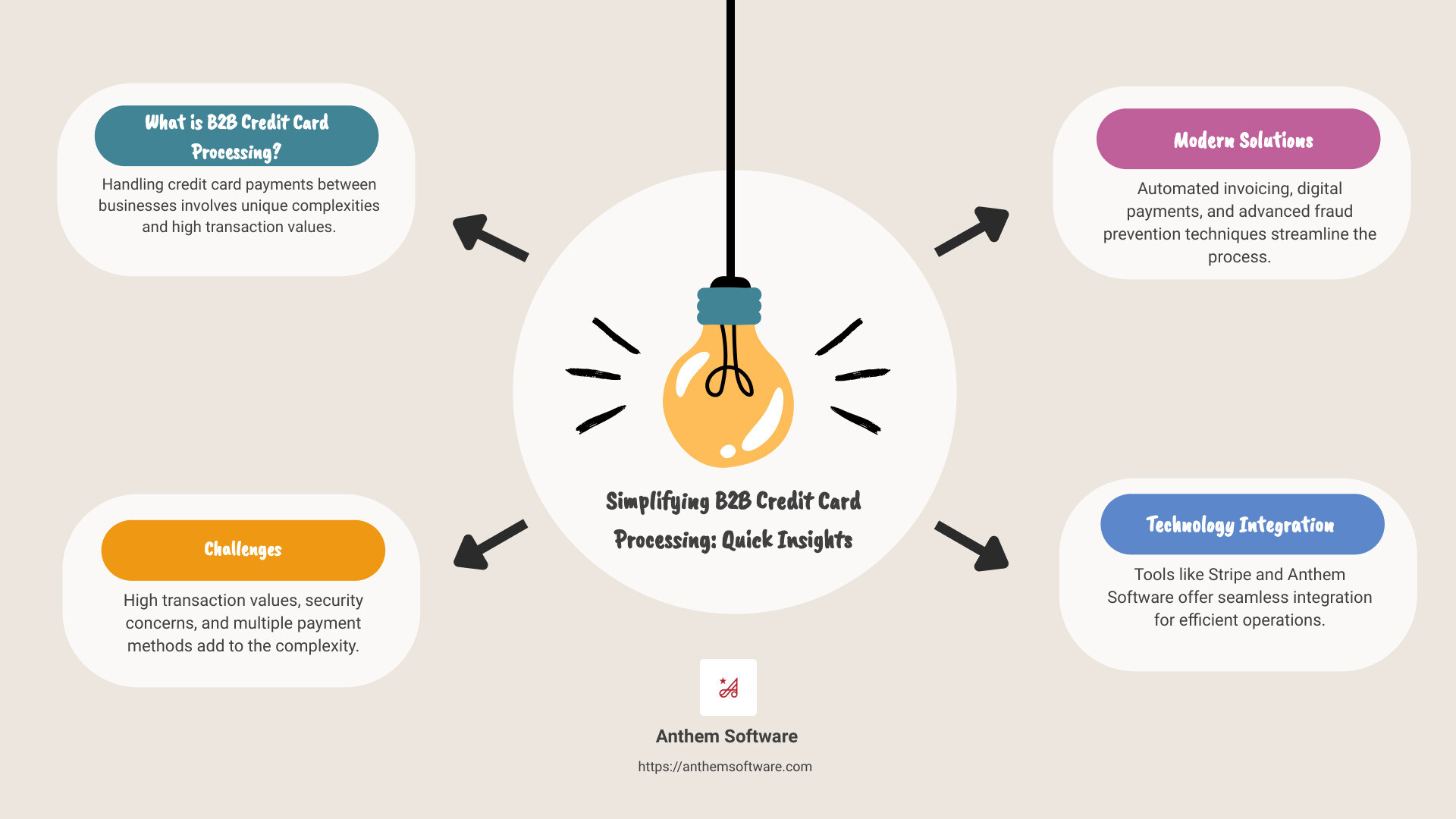
B2B credit card processing is essential yet complex. For quick insight:
- What is it?: B2B credit card processing involves handling credit card payments between businesses.
- Challenges: High transaction values, security concerns, and multiple payment methods.
- Modern Solutions: Automated invoicing, digital payments, and advanced fraud prevention.
B2B payments, made between two businesses, often come with unique challenges. Unlike consumer payments, B2B payments require customized solutions custom to each client’s needs. Businesses may prefer wire transfers, checks, or automated digital payments, based on the transaction size and their internal finance processes.
The complexity of B2B transactions is magnified by the need for detailed documentation, high-value transactions, and the intricacies of international payments. All these add layers of manual work that can hinder fast and accurate processing.
Modern technology provides more efficient alternatives. From automated payment systems to digital invoicing, services like those offered by Stripe and Anthem Software make B2B payments easier. Anthem Software, in particular, offers solutions that integrate seamlessly with your existing systems, providing streamlined operations and better cash flow management.
I’m Joe Amaral. After years in the Navy and corporate sales, I finded my passion for digital marketing, which led me to specialize in B2B credit card processing. Now, I’m here to share what I’ve learned to help you simplify your payment processes.
Stay tuned to understand the nitty-gritty of B2B credit card processing and learn tips to simplify it effectively.
Understanding B2B Credit Card Processing
What is B2B Credit Card Processing?
B2B credit card processing is the method of handling credit card payments between businesses. Unlike consumer transactions, these payments often involve larger sums, longer payment terms, and more complex documentation.
Businesses use B2B credit cards for a variety of transactions, from purchasing supplies to paying for services. These cards often come with rewards schemes and low-interest rates to attract businesses.
Benefits of B2B Credit Card Processing
Lower Processing Rates: One of the main benefits of B2B credit card processing is the potential for lower processing rates. Many B2B transactions qualify for level 2 and level 3 card processing, which involves providing additional transaction data. This can significantly reduce processing costs compared to standard consumer transactions.
Improved Cash Flow Management: Using credit cards for B2B payments helps businesses manage their cash flow more effectively. Payments can be made instantly, reducing the time spent waiting for checks to clear or wire transfers to process. This immediacy helps businesses maintain a steady cash flow, which is crucial for day-to-day operations.
Reward Schemes and Low-Interest Rates: Many B2B credit cards offer reward schemes, such as cash back or travel points, which can be beneficial for businesses. Additionally, these cards often come with lower interest rates compared to consumer cards, making them a cost-effective option for managing business expenses.
Transaction Complexity: B2B transactions are often more complex than consumer transactions. They may involve negotiated terms, large sums, and detailed documentation. However, modern payment solutions can simplify these processes. Automated invoicing, advanced online reporting, and integration with accounting systems can streamline operations and reduce manual work.
Security and Fraud Prevention: Security is a major concern in B2B transactions. Advanced fraud prevention measures and compliance with security standards are essential. Payment processors like Anthem Software provide secure payment gateways that encrypt data and verify identities, ensuring the safety of financial transactions.
In summary, B2B credit card processing offers numerous benefits, including lower processing rates, improved cash flow management, and improved security. By leveraging modern payment solutions, businesses can simplify their payment processes and focus on growth.
Stay tuned to learn about common B2B payment methods and how to choose the right one for your business.
Common B2B Payment Methods
Understanding the various B2B payment methods can help businesses choose the most efficient and cost-effective options. Here’s a look at some common methods:
ACH Payments
ACH payments are electronic funds transfers made through the Automated Clearing House (ACH) network. These are popular for recurring payments due to their cost-effectiveness.
Advantages:
– Cost-effective: Lower processing fees compared to wire transfers or credit cards.
– Suitable for recurring payments: Ideal for regular transactions like subscriptions or monthly bills.
Disadvantages:
– Processing time: ACH transfers can take 1-2 business days to complete.
– Complex international transactions: Involvement of intermediary banks and compliance with international regulations can complicate cross-border ACH payments.
Credit Cards/B2B Credit Cards
Credit cards, especially B2B credit cards, are commonly used for business transactions, including lower-value purchases.
Advantages:
– Immediate processing: Transactions are processed instantly.
– Rewards and fraud protection: Many cards offer reward schemes like cash back and come with fraud protection.
– Level 2 and Level 3 processing: These levels require additional transaction data, lowering processing costs.
Disadvantages:
– Higher transaction fees: Fees are generally higher than ACH payments.
– Fraud risk: There’s a higher risk of fraud compared to ACH and wire transfers.
Wire Transfers
Wire transfers are electronic transfers of funds from one bank account to another, without intermediary financial institutions.
Advantages:
– Immediate and secure: Funds are transferred in real-time and the process is highly secure.
– Ideal for large transactions: Suitable for significant sums, both domestically and internationally.
Disadvantages:
– High fees: Both sending and receiving banks charge higher fees.
– Irreversible: Once initiated, wire transfers cannot be reversed.
Payment Gateways
Payment gateways facilitate online transactions, allowing businesses to accept payments via various methods through a single platform.
Advantages:
– Convenience and flexibility: Accept payments from multiple sources like credit cards and digital wallets.
– Security: Advanced security features protect against fraud.
– Integration: Easily integrates with accounting and ERP systems for seamless transaction management.
Disadvantages:
– Variable fees: Fees can be higher than direct bank transfers or ACH payments, especially for credit card transactions.
– Third-party reliance: Businesses must trust the gateway’s security measures and reputation.
Paper Checks and Cash
While less common in modern B2B transactions, paper checks and cash are still used, especially in local transactions.
Advantages:
– Familiarity: Many businesses are accustomed to these traditional methods.
– No electronic fees: No processing fees for using cash or checks.
Disadvantages:
– Inefficiency: Manual processes are time-consuming and prone to errors.
– Tracking and security issues: Harder to track and secure compared to electronic methods.
By understanding these common B2B payment methods, businesses can choose the best options for their needs, balancing cost, efficiency, and security.

Stay tuned to learn about the challenges in B2B credit card processing and how to overcome them.
Challenges in B2B Credit Card Processing
Navigating B2B credit card processing can be daunting. From complex transactions to cross-border payments, there are several challenges businesses face. Let’s break these down:
Complexity and Documentation
B2B transactions often involve larger sums and more intricate terms compared to B2C transactions. Contracts are negotiated, and detailed documentation is required. This complexity can slow down the payment cycle, making cash flow management tricky.
For instance, imagine a property manager purchasing supplies for a community clubhouse. This isn’t a simple swipe-and-go transaction. It involves invoices, purchase orders, and sometimes, multiple approvals. All this paperwork can bog down the process.
Fraud and Security
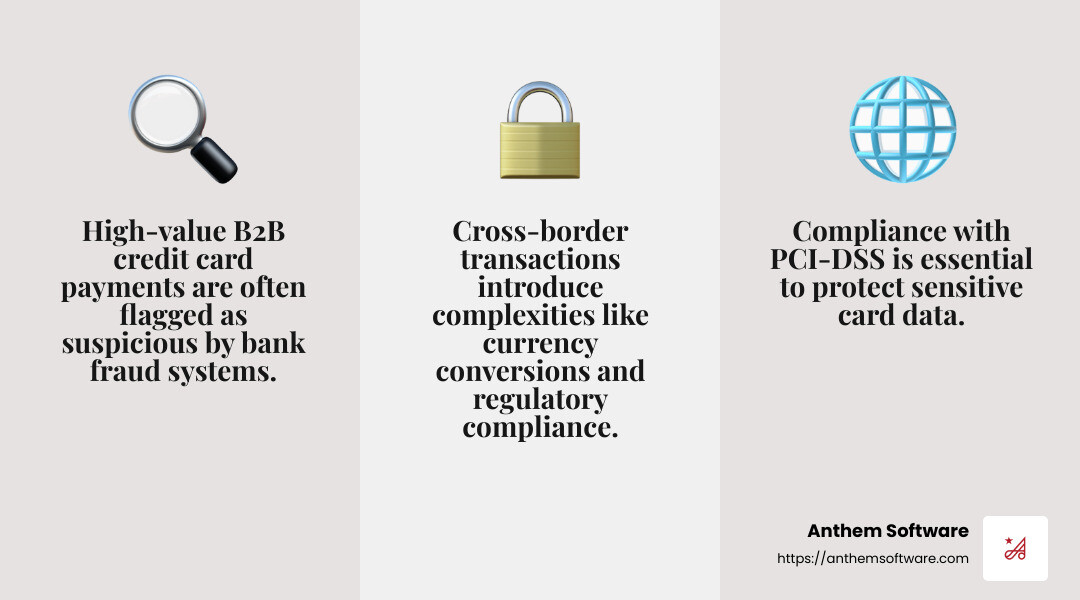
Fraud prevention is a significant concern in B2B credit card processing. High-value transactions can attract fraudsters, and businesses must implement robust security measures. Compliance with regulations like PCI-DSS (Payment Card Industry Data Security Standard) is essential to protect sensitive card data.
A common issue is high-value credit card payments being flagged as suspicious by bank fraud systems. This can lead to payment failures, causing delays and frustration.
Cross-Border Transactions
When dealing with international clients, cross-border transactions introduce additional layers of complexity. Currency conversions, regulatory compliance, and different banking systems can all pose challenges.
For example, a US-based company selling software to clients in Europe must steer various regulations and ensure compliance with GDPR (General Data Protection Regulation). Additionally, they need to manage currency conversions, which can fluctuate and impact the final payment amount.
In summary, B2B credit card processing involves more than just swiping a card. Businesses must handle complex transactions, enforce strong security measures, and manage cross-border payments effectively.
Next, we’ll explore tips for simplifying B2B credit card processing.
Tips for Simplifying B2B Credit Card Processing
Digitizing Payments
Switching to digital payments can streamline your B2B transactions. Moving away from paper-based methods like checks reduces errors, speeds up processing times, and cuts costs.
For example, digitizing payments allows for real-time visibility into your cash flows. You can track payments instantly, making it easier to manage your finances. This shift also improves efficiency by automating routine tasks like invoicing and reconciliation.
Real-Time Payments
Real-time payments are becoming a game-changer in B2B transactions. They enable instant transfer of funds, which can significantly improve cash flow management.
Imagine you’re a supplier waiting on a payment to fulfill a new order. With real-time payments, you receive funds immediately, reducing the risk of late payments and enhancing your ability to meet new demands quickly.
ERP and Accounting System Integration
Integrating your B2B payment processing with ERP (Enterprise Resource Planning) and accounting systems can eliminate data silos and improve data accuracy.
A tightly-integrated payment ecosystem ensures that all your financial data is synchronized across platforms. This leads to more informed decision-making and seamless processes. For instance, integrating payment data with your ERP system can automate the update of inventory levels as soon as a payment is made, reducing manual entry and errors.
Mobile Payments
Mobile payments offer unparalleled convenience and accessibility. With the widespread use of smartphones and tablets, stakeholders can initiate and authorize payments on the go.
This method is particularly useful for remote transactions. For example, mobile payments can be an efficient way to pay remote freelancers or reimburse remote workers quickly. The post-COVID business environment has made mobile payments more relevant than ever.
Blockchain and Cryptocurrency
Blockchain and cryptocurrency are making waves in the B2B payment landscape, especially for international transactions. Blockchain technology offers a decentralized and immutable ledger, enhancing transparency, security, and trust.
Cryptocurrencies can facilitate cross-border payments, bypassing traditional banking intermediaries and reducing transaction costs. For instance, a company dealing with suppliers in different countries can use cryptocurrencies to avoid high bank fees and currency conversion costs.
Adopting these technologies can make your B2B credit card processing more efficient, secure, and cost-effective. By implementing these tips, you can simplify your payment processes and focus more on growing your business.
Choosing the Right B2B Payment Processing Solution
Key Features to Look For
When choosing a B2B payment processing solution, it’s crucial to focus on features that meet your business needs. Here are the key features you should prioritize:
1. Invoicing Tools
Look for platforms with extensive invoicing tools. The ability to create, send, and manage invoices easily is vital. Customizable invoice templates, recurring invoicing, and automated reminders can streamline your invoicing process and improve cash flow management.
2. Multi-Currency Support
If you operate internationally, multi-currency support is a must. This feature allows you to accept payments in various currencies, minimizing conversion fees and making it easier to handle transactions with global clients.
3. Recurring Billing
For businesses offering subscription-based services, recurring billing is essential. This feature automates the billing process, reducing administrative tasks and ensuring timely payments from customers.
4. Customizable Payment Terms
B2B transactions often involve negotiated terms. Choose a platform that offers customizable payment terms. This can include flexible payment schedules, discounts for early payments, and extended credit terms to accommodate your clients’ needs.
5. Security and Compliance
Ensure the platform prioritizes security and compliance. Look for features like tokenization, encryption, and fraud detection. Compliance with industry standards such as PCI DSS is also crucial to protect sensitive payment data.
Top B2B Payment Processing Solutions
Here are some top B2B payment processing solutions that offer the above features:
1. Stripe
Stripe is known for its developer-friendly APIs and ease of integration with other tools. It supports multi-currency transactions and offers robust invoicing tools. However, Stripe lacks integration with PayPal, which can lead to data silos.
2. PayPal
PayPal is widely recognized and easy to use. It offers a range of features, including invoicing and recurring billing. However, it doesn’t integrate well with Stripe, and its subscription cancellation feature can be risky for SaaS companies.
3. Stax
Stax offers transparent pricing and a range of features suitable for B2B transactions, including invoicing and recurring billing. Its focus on security and compliance makes it a reliable choice for businesses.
4. Adyen
Adyen is ideal for enterprise-level companies with dedicated engineering teams. It supports multi-currency transactions and offers flexible APIs for integration. However, it requires significant technical resources to manage.
5. Braintree
Acquired by PayPal, Braintree integrates seamlessly with it, making it a good fit for businesses that already use PayPal. It offers strong invoicing tools and recurring billing, but like Stripe, it doesn’t handle sales tax compliance.
6. Checkout.com
Checkout.com is growing rapidly and offers extensive payment methods and transparent pricing. It also supports payment routing, which can improve success rates for transactions. However, it focuses only on payment processing and lacks features like invoicing and tax compliance.
Choosing the right B2B payment processing solution depends on your specific needs and the features that matter most to your business. Consider the options above to find the best fit for your company.
Frequently Asked Questions about B2B Credit Card Processing
What is B2B Credit Card Processing?
B2B credit card processing refers to the methods and systems used for handling credit card payments between businesses. It’s designed to meet the unique needs of business transactions, which often involve larger sums and more complex terms than consumer payments. B2B credit cards often come with reward schemes and low-interest rates to attract businesses.
These transactions can qualify for Level 2 and Level 3 processing, which involves collecting additional data to lower processing rates. This extra info can include details like tax amounts, purchase order numbers, and item descriptions. Collecting this data can significantly reduce costs for businesses.
How do B2B and B2C Credit Processing Costs Differ?
B2B and B2C credit processing costs differ mainly due to the data levels required. B2C payments usually fall under Level 1 processing, which involves basic data like card number and expiration date. These transactions generally have higher processing rates.
In contrast, many B2B transactions qualify for Level 2 and Level 3 processing. These levels require additional data, such as tax amounts and item details, which reduce the risk for card issuers and thus lower the processing costs. However, if a B2B transaction fails to provide the required data, it can revert to Level 1, incurring higher fees.
What are the Most Common B2B Payment Methods?
B2B payment methods vary widely, depending on the nature and needs of the businesses involved. Here are the most common methods:
- ACH Payments
Electronic funds transfers that are cost-effective and ideal for recurring payments.
Credit Cards/B2B Credit Cards
Often used for their convenience and reward schemes. Level 2 and Level 3 processing can make them more cost-effective.
Wire Transfers
Suitable for large, real-time transfers, including international transactions. They usually come with higher processing fees.
Payment Gateways
These facilitate online payments and offer integration and security benefits.
Paper Checks and Cash
- Though declining in use due to inefficiencies, they are still used for local transactions and when electronic means are not feasible.
Understanding these methods can help businesses choose the best option for their specific needs, balancing cost, convenience, and security.
By addressing these FAQs, we aim to simplify the complex world of B2B credit card processing and help businesses make informed decisions.
Conclusion
At Anthem Software, we understand that digital marketing and efficient payment processing are crucial for the success of B2B businesses. Our expertise in B2B credit card processing and digital marketing strategies can help you achieve your business goals.
Digital Marketing
Digital marketing is essential for reaching and engaging with your target audience. It involves using online channels to promote your products or services, build brand awareness, and drive sales.
At Anthem Software, we offer comprehensive digital marketing solutions custom to your business needs. From SEO and content marketing to social media and email campaigns, we ensure your brand stands out in the digital landscape.
B2B Email Marketing
Email marketing remains one of the most effective ways to communicate with your customers. For B2B businesses, it’s about crafting strategic, personalized messages that resonate with your audience.
Our platform simplifies the creation and management of email campaigns. We use data insights and powerful segmentation capabilities to enable personalized messaging, helping you turn potential leads into loyal customers.
Global Clients
Expanding your reach globally can be challenging, but it’s essential for growth. Our solutions are designed to help you steer different markets and tailor your approach to diverse audiences.
We empower businesses to craft content that resonates across cultures and languages, amplifying their voice and extending their reach far beyond their local market.
Why Choose Anthem Software?
- Comprehensive Solutions: From payment processing to digital marketing, we offer a suite of tools designed to improve efficiency and drive growth.
- Expertise and Experience: With years of experience and a global clientele, we know what it takes to succeed in the digital world.
- Personalized Approach: We tailor our solutions to meet your specific needs, ensuring you get the best results.
To learn more about how we can help simplify your B2B credit card processing and boost your digital marketing efforts, visit our payment processing service page.
Together, we can steer the complexities of B2B payments and digital marketing, driving your business towards sustained growth and success.