

Mastering B2B ACH Payment Processing: A How-To Guide
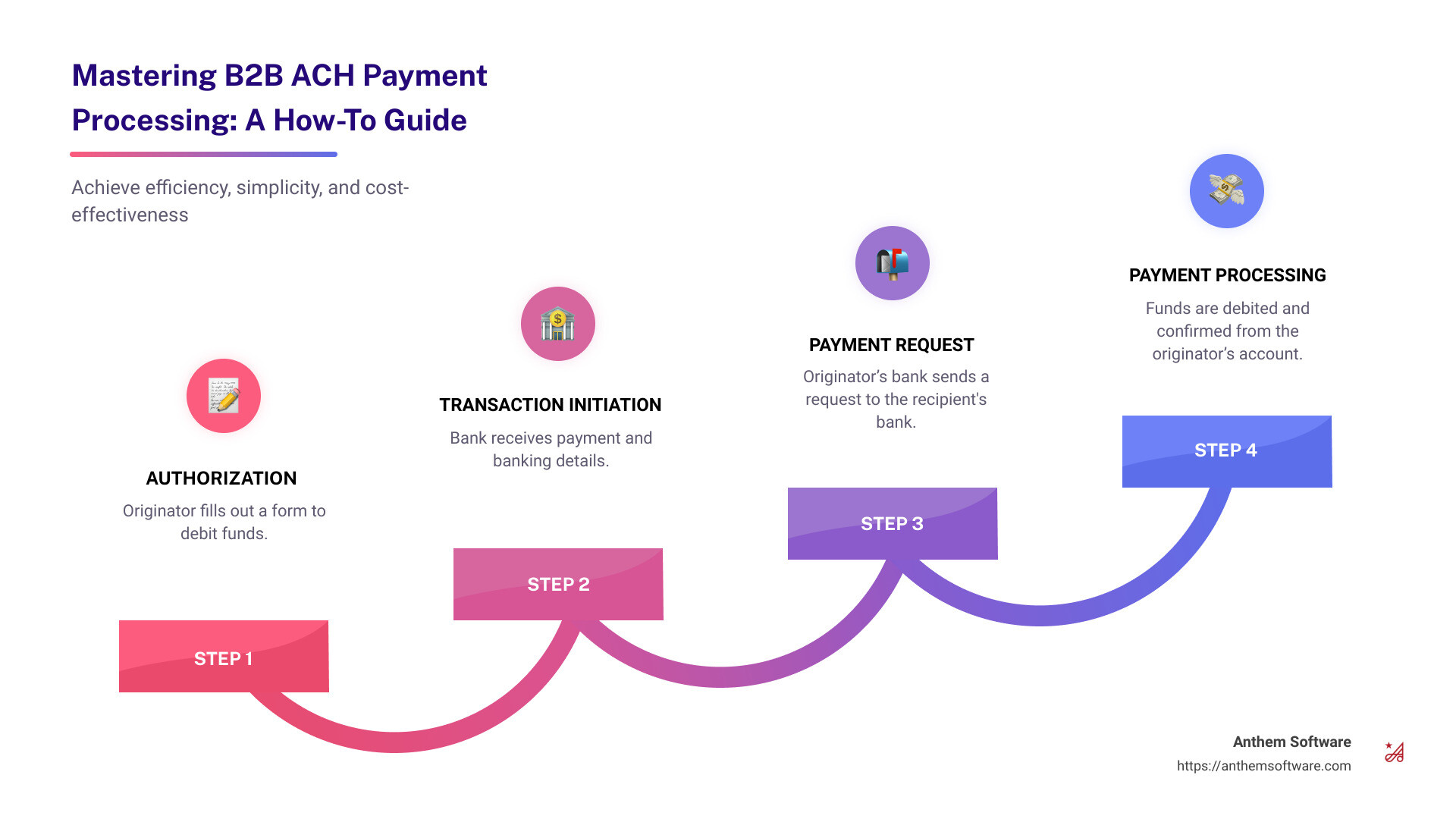
When it comes to b2b ach payment processing, simplicity, efficiency, and cost-effectiveness are key. Here’s a quick breakdown of the essentials:
- Authorization: Originator fills out a form to debit funds.
- Transaction Initiation: Bank receives payment and banking details.
- Payment Request: Originator’s bank sends a request to the recipient’s bank.
- Payment Processing: Funds are debited and confirmed from the originator’s account.
B2B transactions are the backbone of daily operations in any industry, from procuring goods to paying utility bills. While traditional methods like paper checks and credit cards get the job done, they are not always the most efficient or cost-effective. Enter b2b ach payment processing—a streamlined method that offers numerous benefits, including faster transaction times and lower processing fees.
ACH payments are already familiar in the field of direct deposit payroll but hold untapped potential for B2B transactions. Using the Automated Clearing House Network, businesses can ensure smooth and quick transfers with minimal costs. Companies will benefit from improved cash flow, reduced errors, and automated processes, all while keeping the security intact.
I’m Joe Amaral, with years of experience in digital marketing and payment processing solutions. I’ve helped numerous businesses streamline their B2B transactions through effective ACH payment strategies, ensuring they experience the plethora of benefits this system offers.
B2b ach payment processing vocabulary:
– b2b credit card processing
– what is b2b payment processing
What is B2B ACH Payment Processing?
B2B ACH payment processing is an electronic funds transfer (EFT) between two business bank accounts through the Automated Clearing House (ACH) network. Unlike broader EFT methods like wire transfers, ACH focuses specifically on bank-account-to-bank-account transfers within the United States.
Electronic Funds Transfer (EFT) vs. ACH
EFT is a broad term that includes various types of electronic payments, such as wire transfers, credit card payments, and ACH transfers. ACH is a subset of EFT, specifically designed for transferring funds between bank accounts via the ACH network. This network is managed by Nacha (National Automated Clearing House Association), which sets the rules and standards for ACH transactions.
How ACH Works in B2B Transactions
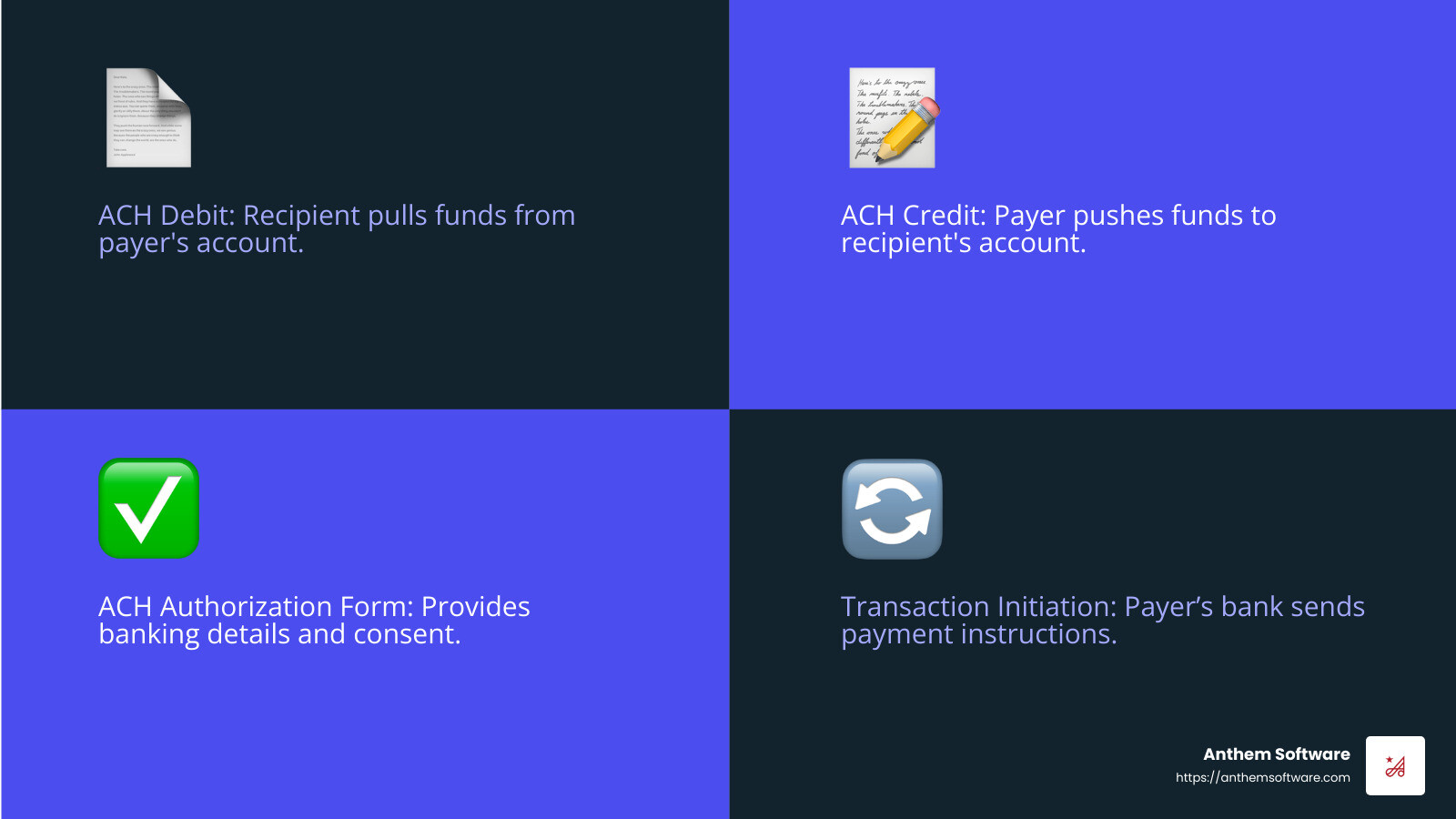
In a B2B ACH transaction, funds move from the payer’s bank account to the payee’s bank account. This can be done in two ways:
– ACH Debit: The recipient initiates the transaction to pull funds from the payer’s account.
– ACH Credit: The payer initiates the transaction to push funds to the recipient’s account.
Here’s a simple breakdown of the process:
- ACH Authorization Form: The payer completes an authorization form, providing banking details and consent for the transaction.
- Transaction Initiation: The payer’s bank (ODFI) sends payment instructions to the ACH Operator.
- Payment Files: The ACH Operator forwards these instructions to the payee’s bank (RDFI).
- Funds Transfer: The payee’s bank processes the payment, crediting the payee’s account and debiting the payer’s account.
Role of Nacha
Nacha oversees the ACH network, ensuring transactions are secure, timely, and compliant with regulations. They provide guidelines for setting up ACH payments, including sample authorization forms and best practices for security.
Why Businesses Prefer ACH
- Cost-Effective: ACH transactions cost between $0.26 to $0.50, significantly lower than credit card fees.
- Efficient: Transactions can be completed within 1-3 business days, with same-day ACH available for faster processing.
- Secure: ACH payments reduce the risk of fraud compared to paper checks, thanks to strict Nacha regulations.
In summary, b2b ach payment processing is a reliable, efficient, and cost-effective method for handling business transactions. It leverages the ACH network to facilitate secure and timely fund transfers between business bank accounts, making it an ideal choice for modern B2B payments.
How B2B ACH Payment Processing Works
Let’s explore the mechanics of B2B ACH payment processing. Understanding each step can help your business make the most of this efficient payment method.
ACH Authorization Form
The first step in the ACH process is obtaining authorization from the payer. This involves filling out an ACH authorization form, which includes:
- Payee Information: Name, address, and contact details.
- Bank Account Details: Account type (checking or savings), routing number, and account number.
Nacha provides a sample Direct Payment Authorization Form which businesses can use as a template. This form ensures all necessary information is collected and consent is granted for the transaction.
ACH Transaction Initiation
Once authorization is secured, the payment initiation begins. Here’s how:
- Originating Depository Financial Institution (ODFI): The payer’s bank, known as the ODFI, starts the process by sending payment instructions to the ACH Operator.
- Payment Instructions: These instructions include the amount to be transferred, the payee’s banking details, and the transaction type (credit or debit).
ACH Payment Processing Steps
The ACH payment process involves several key steps to ensure funds are accurately transferred between accounts.
- ODFI Sends Payment Files: The ODFI packages the payment instructions into ACH payment files and sends them to the ACH Operator.
- ACH Operator: The ACH Operator acts as the middleman, routing the payment files to the Receiving Depository Financial Institution (RDFI), which is the payee’s bank.
- RDFI Receives Files: The RDFI receives the files and processes the transaction.
- Funds Transfer: Depending on the transaction type:
- ACH Credit: The RDFI credits the payee’s account.
- ACH Debit: The RDFI debits the payer’s account.
Role of the Federal Reserve and EPN
The Federal Reserve and the Electronic Payments Network (EPN) are the two main ACH Operators in the U.S. They handle the transfer of payment files between ODFIs and RDFIs, ensuring timely and secure transactions.

Interoperator Payments: If the ODFI and RDFI use different ACH Operators, the payment is routed through both networks to complete the transaction. The Federal Reserve ensures these interoperator payments are settled accurately.
Summary
B2B ACH payment processing simplifies transactions between businesses by automating the transfer of funds through the ACH network. From the initial authorization form to the final fund transfer, each step is designed to be secure, efficient, and cost-effective. This makes ACH an attractive option for businesses looking to streamline their payment processes.
Next, we’ll explore the benefits of B2B ACH payment processing, highlighting why it’s a preferred method for many businesses.
Benefits of B2B ACH Payment Processing
Cost Efficiency
B2B ACH payment processing is incredibly cost-efficient. Unlike credit card transactions, which can incur high interchange fees, ACH transactions typically cost just 1% per transaction with a cap of $10. Compare that to wire transfers, which can cost $15 to $50 per transaction, and you’ll see significant savings. For example, Stax reports that ACH transactions cost an average of $0.29, making it ideal for high-value transactions.
Lower Transaction Fees: ACH payments avoid the hefty interchange rates associated with credit card payments and the high cost of wire transfers. This makes ACH a less expensive option for your business.
No Processing Fees: Many ACH providers offer flat fees, further reducing costs. This is particularly beneficial for businesses with high transaction volumes.
Speed and Convenience
Faster than Checks: ACH payments are faster than traditional checks, which can take days to clear. ACH transactions typically process within 1-3 business days, and with same-day ACH, funds can be available within hours.
Less Labor-Intensive: Automated processes reduce the manual labor involved in processing payments. This frees up your team to focus on more strategic tasks.
Automated Processes: AP automation software like Tipalti can streamline the entire payment process. This software can handle everything from vendor onboarding to payment initiation, making your operations more efficient.
Security and Reliability
Safer than Checks: ACH payments are more secure than paper checks, which are prone to fraud. An estimated 75% of businesses have experienced check fraud, whereas ACH payments are consistently ranked as one of the safest payment methods.
Reduced Fraud Risk: ACH transactions are encrypted and verified, reducing the risk of fraud. This provides peace of mind for both the payer and the payee.
Enterprise-Grade Security: ACH is managed by the US government, which imposes stringent security protocols. Payment processors often go above and beyond these standards to ensure maximum security. For instance, Tipalti offers robust security measures to protect sensitive financial data.
Automation: Automating ACH payments reduces the risk of human error. This not only improves the accuracy of your transactions but also improves overall operational effectiveness.
Environmental Benefits
Reduced Paper Usage: ACH eliminates the need for paper checks, envelopes, and stamps. This is not only more convenient but also environmentally friendly.
Lower Carbon Footprint: By reducing the need for physical transportation of checks, ACH payments contribute to a lower carbon footprint.
By embracing B2B ACH payment processing, your business can enjoy these significant benefits, making it a smart choice for modern financial operations.
Next, we’ll dive into the challenges of B2B ACH payment processing, to help you steer any potential obstacles.
Challenges of B2B ACH Payment Processing
While B2B ACH payment processing offers numerous benefits, it’s not without its challenges. Let’s explore some of the key obstacles you might face.
Domestic-Only Transactions
One of the biggest limitations is that ACH payments are primarily for domestic transactions within the U.S. Although there is an option for global ACH (or international ACH transfer, IAT), it’s less commonly used and not all banks support it. This makes ACH less ideal for businesses with significant international dealings.
Accuracy
Accuracy is crucial when processing ACH payments. You need the correct business name, routing number, and bank account number for the payee. Any mistakes can lead to failed transactions or delays.
Example: A company once had to reprocess hundreds of transactions because of a single digit error in the routing number. This caused delays and frustrated vendors.
Security
While ACH payments are generally secure, they are not immune to risks. Ensuring the safety of sensitive information like bank account details is vital. The US government sets baseline security standards, but additional measures can further protect your transactions.
Anthem Software offers enterprise-grade security, allowing payees to enter their routing and bank account numbers securely. This reduces the risk of data breaches.
Verification Processes
Verification processes are necessary to ensure the legitimacy of ACH transactions. This can be time-consuming and complex, especially for businesses dealing with numerous vendors.
Tip: Automating verification through software like Anthem Software can streamline this process. The software guides payees through entering their information and ensures it’s accurate.
Anthem Software AP Automation
Anthem Software simplifies many of the challenges associated with B2B ACH payments. From vendor onboarding to payment initiation, Anthem Software automates and secures the entire process.
- Self-Service Supplier Portal: Vendors can securely enter their payment information and choose ACH as their preferred method.
- Tax Compliance: The portal also collects W-9 or W-8 information and tracks payments for easy tax reporting.
- Batch Processing: Pay thousands of invoices at once, reducing manual workload and errors.
By addressing these challenges head-on, you can make B2B ACH payment processing a smooth and reliable part of your business operations.
Next, we’ll look at how to set up B2B ACH payments to ensure a seamless experience.
How to Set Up B2B ACH Payments
Setting up B2B ACH payments involves several steps to ensure smooth and secure transactions. Let’s break it down into three main parts: Vendor Onboarding, Payment Initiation, and Reconciliation.
Vendor Onboarding
Vendor onboarding is the first step in setting up B2B ACH payments. It involves collecting and validating important information from your suppliers.
- Collect Supplier Information:
- Obtain W-9 forms for U.S. vendors or W-8 forms for international vendors.
Gather bank account and routing numbers for ACH authorization.
Validate Supplier Information:
Verify the accuracy of the provided information to avoid errors. This can be done through automated systems, which ensure data accuracy and compliance.
3-Way Matching:
Match the invoice to the purchase order and receiving report. This ensures that the goods or services were received as expected before making a payment.
Error Checking:
- Review the invoice for any discrepancies or errors. Automated systems can flag inconsistencies, reducing manual workload.
Payment Initiation
Once the vendor is onboarded, you can initiate payments through the Automated Clearing House (ACH) Network.
- Automated Clearing House Network:
Use an AP automation software to initiate payments. This software can handle large batches of payments, making the process efficient.
Payment Scheduling:
Schedule payments based on agreed terms. You can set up recurring payments for regular expenses, ensuring timely transactions.
Payment Status Communication:
Keep vendors informed about the payment status. Automated systems can send notifications, reducing the need for manual follow-ups.
Record Keeping:
- Maintain detailed records of all transactions. This is crucial for auditing and compliance purposes.
Reconciliation
Reconciliation ensures that all payments are accurately recorded in your accounting systems.
- General Ledger:
Record payments in the general ledger. This provides a clear financial overview and helps in tracking expenses.
Near Real-Time Reconciliation:
Use AP automation software to reconcile payments in near real-time. This reduces the chances of errors and discrepancies.
AP Automation Software:
- Software automates the reconciliation process, matching payments with invoices and updating your accounting systems automatically.
By following these steps, you can set up an efficient and secure B2B ACH payment system. Next, we’ll address some frequently asked questions about B2B ACH payment processing to clear up any remaining doubts.
Frequently Asked Questions about B2B ACH Payment Processing
What is B2B ACH?
B2B ACH stands for Business-to-Business Automated Clearing House. It’s an electronic payment method for transferring funds between businesses. This system is governed by Nacha, the National Automated Clearing House Association.
B2B ACH payments are popular because they are cost-effective, secure, and convenient. Unlike traditional checks or credit card transactions, ACH payments are processed electronically, reducing paperwork and the risk of fraud.
How is an ACH Payment Processed?
ACH payments involve transferring money from one bank account to another using the Automated Clearing House Network. Here’s a simple breakdown of the process:
Authorization: The payer (originator) authorizes the transaction, usually by filling out an ACH authorization form.
Transaction Initiation: The payer’s bank, known as the Originating Depository Financial Institution (ODFI), sends the payment details to an ACH Operator (either the Federal Reserve or a private clearinghouse).
Payment Processing: The ACH Operator sorts and batches the transactions, then sends them to the Receiving Depository Financial Institution (RDFI), which is the payee’s bank.
Account Update: The payee’s bank updates their account, either crediting or debiting the funds, depending on the transaction type.
Nacha’s rules ensure that this process is secure and standardized across all participating banks, making it a reliable method for business payments.
How Long Do B2B Transfers Take?
The time it takes for B2B ACH transfers to complete can vary:
Standard ACH: Typically takes 1-3 business days. This is because transactions are processed in batches at specific intervals.
Same-Day ACH: Introduced by Nacha in 2016, same-day ACH allows for faster processing. Transactions can be completed within the same business day, usually in a few hours.
While same-day ACH is faster, it might come with slightly higher fees compared to standard ACH. However, it is still more cost-effective than other real-time payment methods.
By understanding these basics, businesses can make informed decisions about using B2B ACH for their payment processing needs.
Conclusion
In summary, B2B ACH payment processing offers a reliable, cost-effective, and secure method for businesses to transfer funds. It’s an electronic system governed by Nacha, ensuring standardized and secure transactions across all participating banks.
Benefits
Cost Efficiency: ACH payments typically have lower transaction fees compared to credit cards and wire transfers. For most businesses, this means paying just 1% per transaction with a cap of $10.
Speed and Convenience: ACH transactions are faster than traditional checks, taking 1-3 business days for standard transfers and even offering same-day ACH options.
Security and Reliability: ACH payments are safer than checks, reducing the risk of fraud. Enterprise-grade security protocols are in place, making it one of the most secure payment methods available.
Challenges
Despite its advantages, B2B ACH payment processing does have some challenges. These include:
Domestic-Only: ACH is primarily used within the United States. For international transactions, other methods like global ACH or wire transfers may be required.
Accuracy and Verification: Ensuring the accuracy of routing and account numbers is crucial. Mistakes can delay payments or result in failed transactions.
Adoption and Integration: Not all businesses are set up to accept ACH payments, and integrating ACH processing into existing systems can require effort and resources.
Anthem Software’s Role
At Anthem Software, we specialize in providing efficient payment solutions custom to B2B needs. Our expertise in digital marketing and payment processing helps businesses streamline their transactions, reduce costs, and improve cash flow.
We offer a comprehensive suite of services, including ACH payment processing, to help businesses modernize and secure their payment systems. Our solutions are designed to integrate seamlessly with your existing operations, making the transition to digital payments as smooth as possible.
For more information on how we can help your business with B2B ACH payment processing, visit our payment processing service page.
By leveraging the benefits and addressing the challenges of B2B ACH payments, businesses can achieve greater efficiency, security, and cost savings. Let Anthem Software be your partner in mastering B2B ACH payment processing.