

Changing Business Processes with AI and Automation
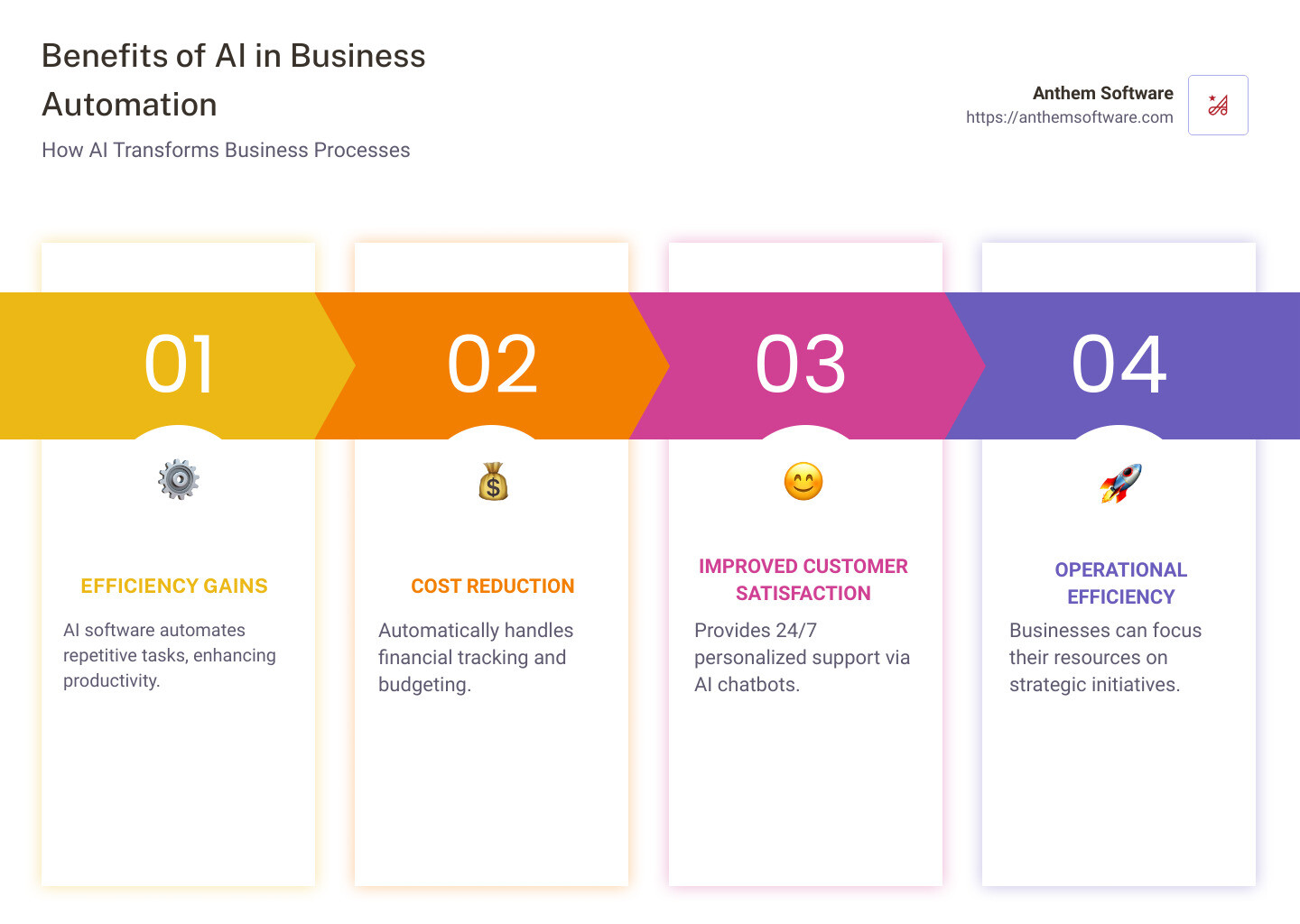
AI uses software to automate business processes, driving efficiency, reducing costs, and boosting customer satisfaction through various methods. Key benefits include:
- Efficiency Gains: AI software automates repetitive tasks, enhancing productivity.
- Cost Reduction: Automatically handles financial tracking and budgeting.
- Improved Customer Satisfaction: Provides 24/7 personalized support via AI chatbots.
Artificial Intelligence (AI) and Business Process Automation (BPA) are revolutionizing the way businesses operate. By automating manual and repetitive tasks, these technologies allow companies to reduce operational costs, improve efficiency, and improve customer satisfaction. For instance, AI can analyze customer data to provide personalized service, while BPA software like QuickBooks takes care of invoicing and expense tracking.
By leveraging AI and BPA, businesses can focus their resources on more strategic initiatives. This leads to not only operational efficiency but also better decision-making and competitive advantage.
I’m Joe Amaral, a digital marketing entrepreneur with a passion for technology and innovation. Through my experience in starting and growing software and marketing businesses, I’ve seen how ai uses software to automate business processes to drive success.
What is AI and Business Process Automation?
Understanding AI
Artificial Intelligence (AI) is the ability of machines to perform tasks that usually require human intelligence. This includes understanding natural language, recognizing patterns, and making decisions. AI systems, like OpenAI’s ChatGPT, use machine learning (ML) and natural language processing (NLP) to learn from data and improve over time.
For example, AI can analyze customer data to provide personalized recommendations. This helps businesses make better decisions and offer custom experiences to their customers.
Understanding Business Process Automation
Business Process Automation (BPA) involves using technology to automate routine business tasks. This can range from simple tasks like data entry to more complex processes like financial tracking. Tools like those offered by Anthem Software are excellent examples of BPA in action. They automate marketing, sales, and customer service tasks, freeing up employees to focus on more strategic activities.
BPA not only improves efficiency but also reduces costs and errors. For instance, Anthem Software’s tools can automate email marketing campaigns and social media posts, ensuring consistency and accuracy.
How AI and BPA Work Together
Combining AI and BPA can transform business operations. AI improves BPA by adding intelligence to automation. For example, AI-powered chatbots can handle customer inquiries 24/7, while BPA software manages the workflow behind the scenes.
This synergy leads to significant benefits:
– Increased Efficiency: Automates repetitive tasks, allowing employees to focus on high-value activities.
– Cost Reduction: Reduces operational costs by minimizing manual labor and errors.
– Improved Accuracy: Ensures consistent and error-free processes.
– Improved Customer Satisfaction: Provides timely and personalized customer support.
Real-World Impact
Many businesses are already reaping the benefits of AI and BPA. For instance, AI-powered financial tools can analyze spending patterns and optimize budgets. Marketing automation tools can segment audiences and deliver personalized content, boosting engagement and conversions.
Anthem Software leverages these technologies to help businesses streamline their operations and achieve better results. By integrating AI and BPA, companies can stay competitive and adapt to the rapidly changing business landscape.
Next, we’ll explore how AI uses software to automate business processes, diving into specific tools and their benefits.
How AI Uses Software to Automate Business Processes
AI-Powered Tools for Business Automation
AI uses software to automate business processes in various ways, enhancing efficiency and reducing costs. Here are some key tools that make this possible:
Anthem Software: Known for its comprehensive suite of tools, Anthem Software automates tasks like email marketing, social media posting, and customer relationship management (CRM). This frees up time for employees to focus on more strategic activities.
ChatGPT: Developed by OpenAI, ChatGPT can handle customer inquiries, generate content, and provide instant responses. This AI-powered tool helps businesses offer 24/7 customer support without human intervention.
Custom AI Solutions: Many companies develop custom AI solutions to meet their specific needs. These can include anything from automated financial management tools to predictive analytics for marketing campaigns.
Financial Management Tools: AI-driven financial tools can analyze spending patterns, predict future expenses, and optimize budgets. This not only saves time but also ensures more accurate financial planning.
Benefits of AI in Business Process Automation
Implementing AI in business process automation brings several notable benefits:
Efficiency: AI automates repetitive tasks, allowing employees to focus on high-value activities. For instance, AI can handle data entry, scheduling, and even complex tasks like financial analysis.
Cost Reduction: By automating routine tasks, businesses can significantly reduce labor costs. AI systems work round-the-clock without needing breaks, leading to continuous productivity.
Accuracy: AI minimizes human errors in tasks like data entry and financial tracking. This ensures that business processes are consistent and error-free, improving overall service quality.
Customer Satisfaction: AI-powered tools like chatbots provide instant responses to customer inquiries, enhancing the customer experience. Personalized recommendations based on AI analysis can also increase customer loyalty.
Scalability: AI solutions can easily scale with your business. Whether you’re expanding your customer base or adding new services, AI can handle increased workloads without compromising performance.
For example, Anthem Software leverages AI to automate marketing campaigns, ensuring timely and personalized communication with customers. This not only boosts engagement but also drives conversions, leading to business growth.
By integrating AI and BPA, companies can streamline their operations, reduce costs, and improve customer satisfaction. Next, we’ll explore how to implement these technologies in your business.
Implementing AI and BPA in Your Business
Step-by-Step Guide to Implementing AI and BPA
Implementing AI and Business Process Automation (BPA) can significantly improve your business operations. Here’s a step-by-step guide to help you get started:
Step 1: Identify Processes
Begin by identifying which business processes can benefit from automation. Focus on repetitive, rule-based tasks such as data entry, form filling, and data extraction.
Step 2: Data Collection and Preparation
Collect and prepare the data needed to train your AI models. This could include historical data, customer interactions, or any other relevant information that will help your AI system learn effectively.
Step 3: Choose AI Techniques
Select the appropriate AI techniques for your specific needs. For example:
– Natural Language Processing (NLP) for understanding and generating human language.
– Machine Learning for predictive analytics, classification, and regression.
– Computer Vision for image and video analysis.
– Reinforcement Learning for optimizing sequential decision-making.
Step 4: Model Development
Develop and train AI models using the collected data. This involves coding algorithms, fine-tuning hyperparameters, and testing different model architectures to find the best fit for your business needs.
Step 5: Integration
Integrate the trained AI models into your existing systems. Develop APIs to enable seamless communication between the AI models and other software applications.
Step 6: Testing and Optimization
Thoroughly test the AI models to ensure accuracy, reliability, and performance. Continuously optimize the models based on feedback and new data.
Step 7: Deployment
Deploy the AI automation solution to your business processes. Monitor its performance and gather insights to identify opportunities for improvement.
Step 8: Continuous Learning
AI models can be further improved by continuously training them with new data and adapting to changing business conditions.
Step 9: Scalability
As you gain experience and confidence in AI and BPA, scale the automation to other processes within your organization.
Overcoming Challenges in AI and BPA Implementation
While AI and BPA offer numerous benefits, they also come with challenges. Here’s how to steer them:
Resistance to Change
Employees might resist the implementation of AI and BPA due to fear of job loss or unfamiliarity with the technology. To address this:
– Provide training sessions to familiarize employees with the new technology.
– Communicate the benefits of AI and BPA, emphasizing how it can make their jobs easier and more efficient.
Data Privacy
Ensuring data privacy is crucial when implementing AI and BPA. To mitigate risks:
– Implement strong data encryption and security measures.
– Regularly audit your systems for vulnerabilities.
– Comply with data protection regulations such as GDPR or CCPA.
Training and Integration Issues
Training AI models and integrating them into existing systems can be complex. To overcome these problems:
– Collaborate with experts in AI and BPA to develop and train your models.
– Use robust integration tools to ensure seamless communication between AI models and existing software.
Scalability
Scaling AI and BPA solutions can be challenging as your business grows. To ensure scalability:
– Choose AI and BPA tools that are designed to scale with your business.
– Continuously monitor and optimize your systems to handle increased workloads.
By following this guide and addressing potential challenges, you can successfully implement AI and BPA in your business. This will streamline operations, reduce costs, and improve overall efficiency.
Next, we’ll explore real-world applications of AI and BPA across various industries.
Real-World Applications of AI and BPA
AI in Customer Support
AI has revolutionized customer support, making it more efficient and responsive. AI chatbots are a prime example. They provide 24/7 support, answering frequently asked questions and guiding customers through common issues.
For instance, AI-driven chatbots can handle account inquiries or product information requests, allowing human agents to focus on more complex issues. This not only improves customer satisfaction but also boosts efficiency.
Moreover, AI can offer personalized recommendations. By analyzing customer data, AI systems can suggest products or services custom to individual preferences. This personalized touch improves the customer experience, fostering loyalty and repeat business.
AI in Marketing Automation
AI is also changing marketing automation. Tools like Anthem Software enable businesses to automate lead generation and email marketing campaigns. By analyzing customer behavior and preferences, AI can create highly targeted marketing strategies.
For example, predictive analytics powered by AI can forecast customer needs and optimize marketing efforts. This can significantly improve the return on investment for marketing campaigns.
Case Study: A small business using AI-driven email marketing saw a 20% increase in open rates and a 15% boost in conversion rates. The AI analyzed past campaign data to optimize email content and timing, leading to better engagement.
AI in Financial Analysis
In the financial sector, AI is making a big impact. AI-powered tools can automate tasks such as expense tracking and budget optimization. For instance, Anthem Software Financial Tools use AI to analyze spending patterns and suggest cost-saving measures.
Predictive analytics is another powerful application. AI can forecast financial trends and help businesses make informed decisions. This not only improves financial planning but also improves overall business strategy.
Example: A company used AI to predict cash flow issues months in advance, allowing them to take proactive measures and avoid financial crises.
AI in Supply Chain Management
AI is streamlining supply chain management by automating inventory tracking, demand forecasting, and logistics planning. AI systems can analyze vast amounts of data to predict supply chain disruptions and optimize resource allocation.
For example, AI can help businesses maintain optimal inventory levels by predicting demand patterns. This reduces the risk of overstocking or stockouts, leading to cost savings and improved customer satisfaction.
Stat: Companies using AI for supply chain management have reported a 15% reduction in inventory costs and a 20% improvement in order accuracy 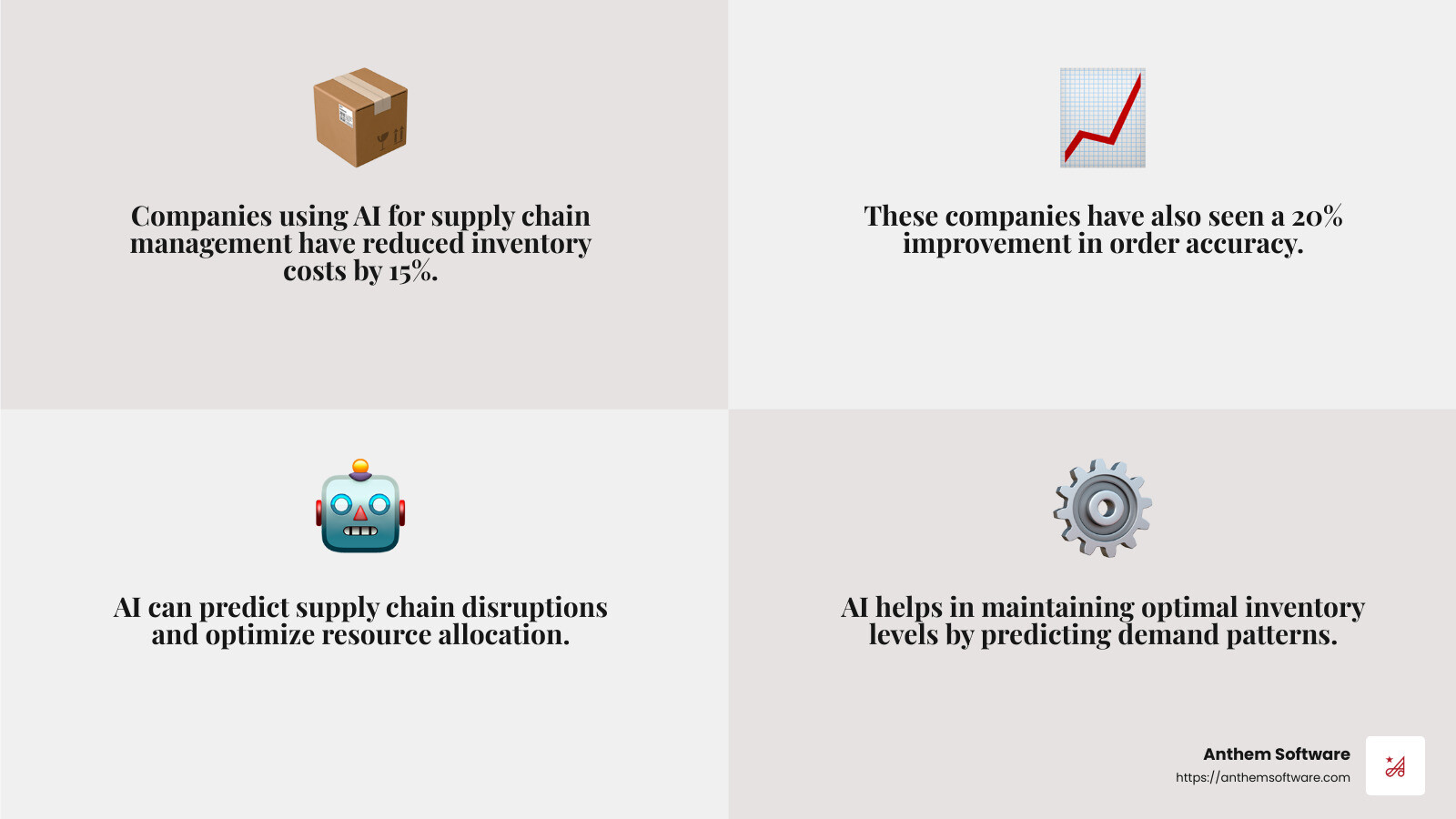 .
AI in CRM Systems
Customer Relationship Management (CRM) systems are also benefiting from AI. Tools like Anthem Software use AI to provide a 360-degree view of the customer, tracking interactions and preferences.
This allows businesses to tailor their communications and offerings to individual customers, enhancing the overall customer experience. AI can also automate routine CRM tasks, freeing up time for sales teams to focus on building relationships and closing deals.
Example: A business using AI-improved CRM saw a 25% increase in customer retention rates by automating personalized follow-up emails and reminders.
By leveraging AI and BPA, businesses can transform their operations, improve efficiency, and improve customer satisfaction. Next, we’ll dig into the frequently asked questions about AI and BPA to address common concerns and provide further insights.
Frequently Asked Questions about AI and BPA
How can AI automate business processes?
AI uses software to automate business processes by employing machine learning and pattern recognition. These technologies can handle complex tasks like data analysis, natural language processing, and predictive analytics.
For example:
Invoice Handling: AI can automate invoice processing, reducing errors and speeding up payment cycles. This ensures timely payments and improved cash flow management.
Workflow Automation: AI can streamline workflows by automating repetitive tasks, such as data entry and document processing. This frees up employees to focus on higher-value activities.
What technology is used to automate business processes?
Several technologies are used to automate business processes, including:
Robotic Process Automation (RPA): RPA uses bots to mimic human actions, automating repetitive tasks like data entry and form filling. Tools like Anthem RPA are popular in this space.
Intelligent Document Processing (IDP): IDP automates the extraction and processing of information from documents. It uses AI to understand and categorize data, making it useful for tasks like invoice processing and compliance checks.
Workflow Orchestration: This involves coordinating multiple automated tasks to work together seamlessly. It ensures that different parts of a process are executed in the correct order and at the right time.
Integrated Systems: AI can integrate with existing systems, such as CRM or ERP software, to improve their capabilities. This allows businesses to leverage AI without overhauling their entire infrastructure.
What is an AI automation business?
An AI automation business specializes in providing AI solutions to automate various business processes. These companies offer services such as:
AI Automation Agency: These agencies consult with businesses to identify automation opportunities and implement AI-driven solutions. They often provide end-to-end services, from strategy development to deployment and maintenance.
Consulting: AI consultants help businesses understand how AI can be applied to their specific needs. They offer expertise in selecting the right technologies and designing custom solutions.
AI Solutions: These are custom AI applications designed to address specific business challenges. They can range from chatbots for customer service to predictive analytics for financial forecasting.
No Coding Expertise: Modern AI solutions often come with user-friendly interfaces that require little to no coding expertise. This makes it easier for businesses to adopt and implement AI technologies without needing specialized technical skills.
By understanding these key aspects, businesses can better steer the landscape of AI and BPA, leveraging these technologies to drive efficiency and innovation.
Conclusion
AI and Business Process Automation (BPA) are revolutionizing the way we operate. By leveraging AI’s capabilities in machine learning, pattern recognition, and natural language processing, businesses can automate complex tasks such as data analysis and predictive analytics. This leads to significant improvements in efficiency and cost reduction.
For instance, AI can handle invoice processing, reducing errors and speeding up payment cycles. This ensures timely payments and better cash flow management. Similarly, workflow automation powered by AI frees up employees from repetitive tasks like data entry, allowing them to focus on more strategic activities.
Efficiency is one of the standout benefits of AI and BPA. Automating routine tasks not only speeds up processes but also reduces human error. This means higher accuracy in operations, which translates to better quality and reliability.
Cost Reduction is another major advantage. By automating tasks that were previously manual, businesses can save on labor costs and reduce the time spent on each task. This can lead to substantial financial savings over time.
Customer Satisfaction also sees a boost with AI and BPA. Tools like AI-powered chatbots offer 24/7 customer support, providing quick and accurate responses to customer inquiries. This improves the overall customer experience and builds stronger customer relationships.
At Anthem Software, we specialize in helping businesses harness the power of AI and BPA to open up their full potential. Our seasoned Business Process Management Consultants can guide you through setting up and implementing these technologies custom to your unique needs.
Don’t let outdated systems slow you down. Accept the power of AI and BPA to create a sustainable, productive, and efficient business process. Visit our Business Equipment Leasing page to learn more about how we can help you stay ahead in a rapidly evolving marketplace.
In conclusion, AI and BPA are not just buzzwords; they are essential tools for modern businesses aiming to improve efficiency, reduce costs, and improve customer satisfaction. By integrating these technologies, you can drive continuous improvement and stay competitive in today’s business environment.